PRO/PL> Undiagnosed sudden decline, apple - USA
(promed@promedmail.org)
Date: Fri, 29 Dec 2017 03:02:35 +0000
From: promed@promedmail.org
Subject: PRO/PL> Undiagnosed sudden decline, apple - USA
To: promed-post@promedmail.org, promed-plant-post@promedmail.org
UNDIAGNOSED SUDDEN DECLINE, APPLE - USA
***************************************
A ProMED-mail post
<http://www.promedmail.org>
ProMED-mail is a program of the
International Society for Infectious Diseases <http://www.isid.org>
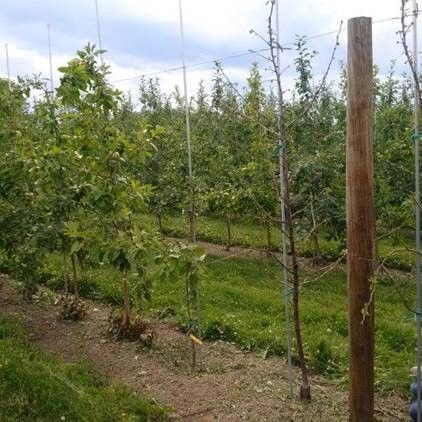
In the Northeast [of the US], Canada and North Carolina, young dwarf trees in
high-density orchards are dying [see ProMED-mail post http://promedmail.org/post/20100608.1911] with increased frequency.
The Pennsylvania Department of Agriculture, Cornell University, University of
North Carolina and others have teamed up to solve the mystery of Rapid (or
Sudden) Apple Decline (RAD or SAD).
There seems to be some connection to M9 rootstock, although other rootstocks
also can be impacted. Fuji, Gala and Golden Delicious cultivars appear most
susceptible. This might indicate some cultivar-rootstock combination
triggering RAD. Observations do not point to any specific pathogen, abiotic
factors may play a role, [but] there is no obvious common denominator among
the impacted trees.
Trees, even those full of fruit, quickly die from RAD. The graft union shows
necrosis [which] continues up the bark. Severe bark shedding near the graft
union [and] cankers are also seen. Within 2 to 3 weeks, leaves turn yellow
and the tree dies. There are few signals that anything is wrong prior to the
sudden emergence of symptoms. Trees collapse completely, despite the wood
being solid and the roots healthy. In any given block, trees with RAD are
scattered with no pattern, [and] some trees can remain healthy.
Because stress is believed to be a factor in RAD, growers are advised to
eliminate as many stressors as possible. Alternative rootstocks to
M9 could afford protection. Other [factors] may be playing some role in the
syndrome and viruses or [other] pathogens - known or as yet unidentified -
may also be contributing.
[This undiagnosed disease or disorder in apple orchards was previously
reported from Michigan and New York (ProMED-mail post http://promedmail.org/post/20100608.1911). It now appears to be much more
widely distributed but unfortunately not much progress seems to have been
made in the search for a cause.
Association with specific dwarfing rootstocks and apple varieties may imply
graft transmissible agents such as viruses, viroids or phytoplasmas.
Molecular methods are needed for their detection, but no information is
provided in the report above whether a systematic molecular search for any
pathogens has already been undertaken. As mentioned above, SAD may also
represent a syndrome including a number of different factors, which would
make the task of identifying a cause much more complex.
Generally, to identify a biotic or abiotic cause for a disease or disorder of
unknown aetiology, a defined process must be followed:
description of specific symptoms in individual plants; patterns of their
distribution in space and time; evidence for or against transmission of
symptoms and spread of the condition; Koch's rules (i.e. to re-isolate an
infectious pathogen after culture and transmission, or equivalent process for
non-culturable pathogens) to test for causation by a biotic agent; molecular
studies to identify a known or characterise a novel potential infectious
agent. Especially in slow growing hosts, such as trees, this process may take
many years and it would be complicated considerably if a previously unknown
pathogen were to be involved.
*##########################################################*
************************************************************
ProMED-mail makes every effort to verify the reports that are posted,
but the accuracy and completeness of the
information, and of any statements or opinions based
thereon, are not guaranteed. The reader assumes all risks in
using information posted or archived by ProMED-mail. ISID
and its associated service providers shall not be held responsible for
errors or omissions or held liable for any damages incurred as a result of
use or reliance upon posted or archived material.
************************************************************
Donate to ProMED-mail. Details available at:
<http://www.isid.org/donate/>
************************************************************
Visit ProMED-mail's web site at <http://www.promedmail.org>.
Send all items for posting to: promed@promedmail.org (NOT to an individual
moderator). If you do not give your full name name and affiliation, it may not be
posted. You may unsub- scribe at
<http://ww4.isid.org/promedmail/subscribe.php>.
For assistance from a human being, send mail to:
<postmaster@promedmail.org>.
############################################################
############################################################