For more than 8,000 years, Tibetan nomads have lived in perfect harmony
with their surroundings. They have been the virtual custodians of the vast
grasslands of Central Tibet, Amdo (northeast) and Kham (southeast), because
they know their survival depends upon this land.
They are pastoral nomads, constantly moving from one place to another to
find the best grazing grounds for their herds of yaks, sheep, goats and
horses. Over the centuries, these hardy people have managed to develop a
deep understanding of grassland dynamics and veterinary knowledge necessary
to survive in the area’s harsh and often inhospitable terrain and weather.
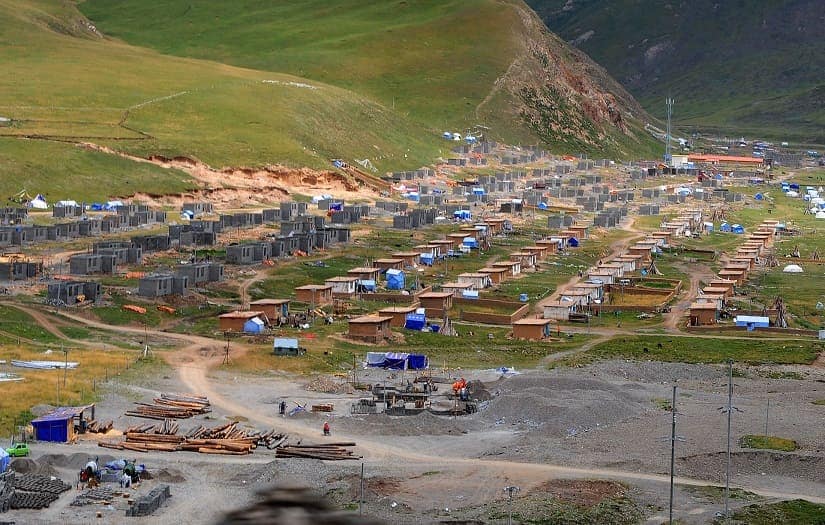
Concrete settlements for Tibetan nomads. Photo courtesy Michael Buckley
Till date — that is, six decades and several catastrophic Chinese policies
later — the systemic plunder of the Tibetan region continues unabated.
Apart from exporting precious resources to far-off Chinese cities, under
threat is the Tibetan way of life, which is being gradually snuffed out by
state-backed policies targeted at ‘resettling’ Tibetan nomads.
*The Chinese Pleas for Resettling Tibetan Nomads*
The Chinese want the world to believe that Tibetan nomads have caused
untold damage to the vast grasslands and destroyed the natural habitat of
the area. They squarely pin the blame for erosion and gradual
desertification in the area on overgrazing caused by the nomads’ animals.
Experts, however, hold that unlike the cashmere goats of Kashmir and
Mongolia which graze voraciously by devouring greenery and uprooting all
grass, the yaks graze lightly and without causing any significant damage.
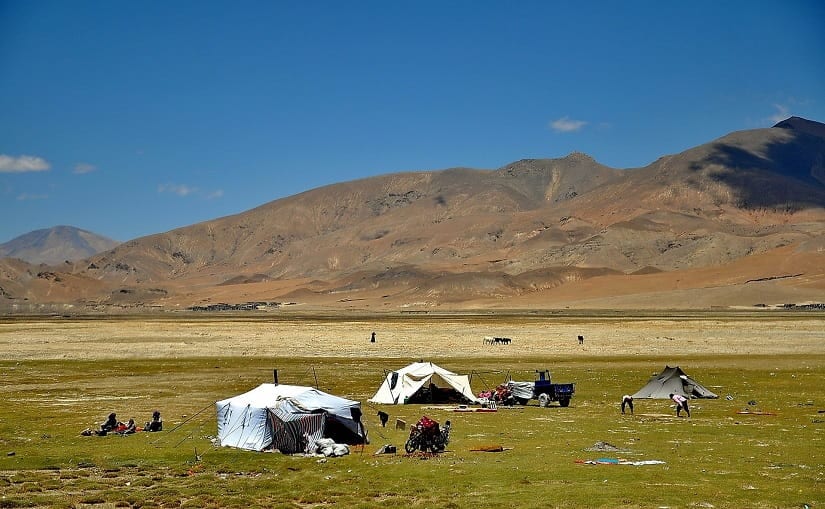
[image: A nomadic settlement]
<https://images.firstpost.com/wp-content/uploads/2019/04/Nomadic-settlement-min.jpg>
A nomadic settlement
Julia Klein, an assistant professor of Ecosystem Science and Sustainability
at Colorado State University, studied with her team the impact of the
traditional nomadic grazing system on the Tibetan grasslands; Klein holds
that grazing provides nutrients for the topsoil, thereby helping in the
regeneration of grass instead of causing damage.
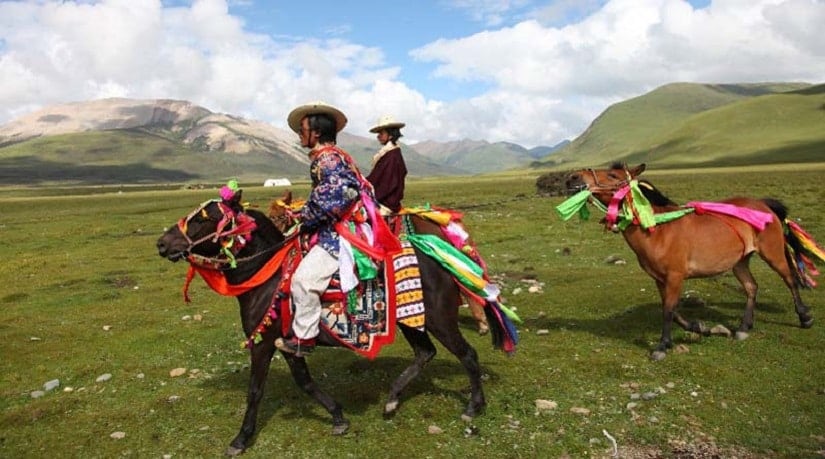
Nomads from Zoige county, Ngawa Prefecture. Photo courtesy The Land of Snows
“Decades of experience with livestock development in other pastoral areas
of the world and considerable recent research in Asia, including Tibetan
areas, all lead to the conclusion that settling nomads is not appropriate,”
says Miller.
The other reason cited by the Chinese authorities for the ‘need’ to
relocate the Tibetan nomads is the ‘inconvenience’ these people face due to
lack of access to drinking water, sanitation, education and medical
facilities.
In his book *Meltdown in Tibet*, Buckley elaborates that the nomads thus
‘relocated’ ostensibly to ease their hardships end up in concrete hovels
where they have little chance of earning enough to make both ends meet.
Tibetan nomads have served as 'stewards' of the grasslands. Photo courtesy
DIIR
*Refugees in Their Own Land*
Michael Buckley, who has visited Tibet several times over the last three
decades, managed to meet some former nomads in Tibet. However, he found it
extremely difficult to make much headway even with the help of local
translators, because of their thick distinctive dialects. Much to his
dismay, he found out that the former nomads who had long fled Tibet were
also hesitant to disclose share their names or whereabouts, fearing that
doing so could endanger their relatives back home.
“The long arm of China continues to threaten them,” he says, adding that he
had to turn to transcripts of interviews of former nomads at the
Mcleodganj-based Environment and Development Desk to know more.
Buckley refers in particular to the testimony of Dhondup, a Golak nomad
from Pema County in Amdo, based on his interview recorded in 2006.
“I have seen Golok nomads on pilgrimage at Labrang Monastery in Gansu —
they are a rugged and fierce-looking people. The toughest of the nomads,
with even their name meaning ‘head facing backwards’. They are a
belligerent race, known to offer stiff resistance to all invaders, staving
off occupation by Chinese, Mongolian, or central Tibetan forces. And yet
the Chinese managed to shovel them into concrete settlements,” Buckley
writes in his book.
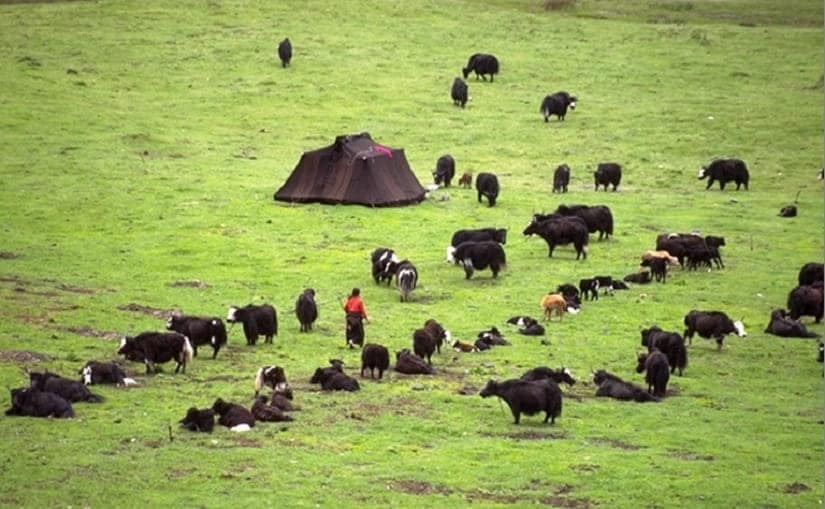
[image: Tibetan-nomads-yaks Picture Courtesy- Michael Buckley-min]
<https://images.firstpost.com/wp-content/uploads/2019/04/Tibetan-nomads-yaks-Picture-Courtesy-Michael-Buckley-min.jpg>
Tibetan nomads. Photo courtesy Michael Buckley
Tenzin Norbu, a senior researcher in the environmental engineering
programme and a trained environmental expert, spoke at length to Buckley
about the Chinese policy of resettling Tibetan nomads.
“First they pushed the nomads out of their homelands saying they have a
backward lifestyle. Fine...what did they do to these nomads after
relocating them?”
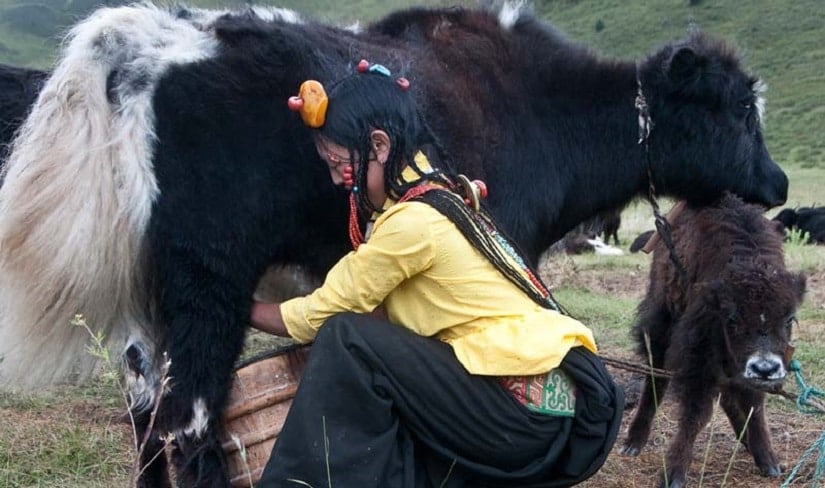
The nomads would earlier barter their surplus yak milk, butter and cheese
with farmers who led settled lives, to get *tsampa* (roasted barley flour)
and clothes, thus leading lives that didn’t lack for the basics.
A Tibetan nomad woman milks a yak. Photo courtesy Michael Buckley
Settled nomads do get an annual subsidy by the government, but that is a
tiny amount, most of which goes towards buying necessities like yak milk,
cheese and butter — all- things they had never had to buy earlier. In
addition to these, they need money to pay for , and taxes — something they
had never had to do earlier!
There are no schools, observed
<https://www.pri.org/stories/2011-01-06/resettling-tibetan-nomads> Olivier
de Schutter, the UN Special Rapporteur on the Right to Food, while vocally
opposing the resettlement policy after visiting China in December 2010. The
few schools that do exist serve only one purpose: namely carrying forward
the state-sponsored “Love the Motherland” propaganda. Nor are there any
medical facilities worth their name.
“Educating them and training them to take up new jobs in a new setup might
have made sense. But did these people want to be educated in the first
place?” Norbu asks. “Do we see any training programmes before or after
moving them? None, nothing at all.”
Decent jobs are a distant dream even for the able-bodied because they
cannot speak or read Chinese, a key requirement to find well-paying work.
In a scenario like this, it is easy for a large number of them to drift
towards alcoholism, gambling and prostitution, or just while away time by
playing pool and video games.
Adding to their woes is the absence of temples or stupas in these ‘modern’
settlements, nor any resident monks to help them overcome their feelings of
emptiness, points out
<https://www.nybooks.com/daily/2016/01/11/why-are-tibetans-self-immolating/>
Tsering Woeser, a popular Tibetan activist and blogger.
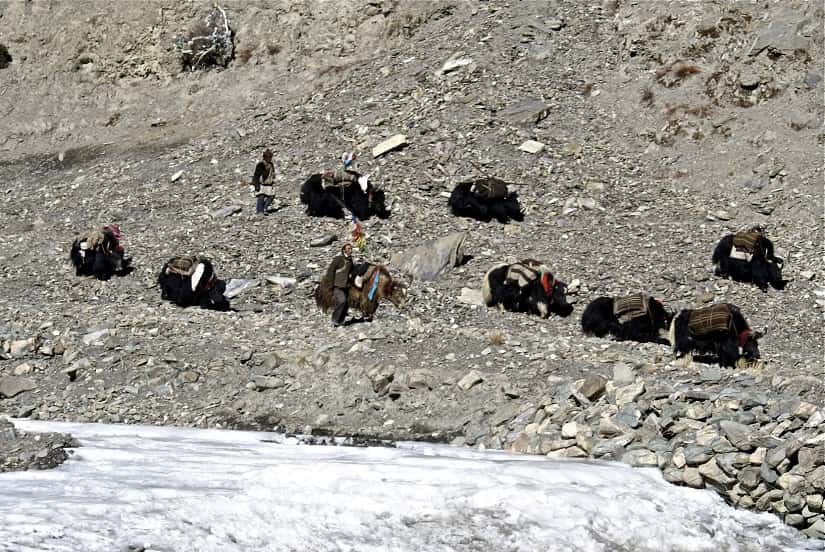
Yak herders moving their herds in Tingri — Southwest Tar. Photo courtesy
The Land of Snows
With the Chinese government being tight-lipped on the issue, exact figures
are hard to come by but even by conservative estimates, nearly a million
nomads and an equal number of Tibetan farmers had been moved off their land
by the Chinese by 2014, says Michael Buckley.
Tempa Gyaltsen Zhamla who heads the Environment and Development Desk at
Tibet Policy Institute (TPI) believes the number of nomads thus forcefully
displaced from their homelands could now be well above the two million mark!
The government stance towards Tibetan nomads has hardened particularly
after the 2008 protest against the Chinese rule. Initiated by monks from
Sera and Drepung monasteries, the uprising went on to involve Tibetans from
almost all walks of life, and goes on record as the biggest rebellion by
Tibetans after 1959, the year when their spiritual guru, His Holiness the
Dalai Lama, fled into India.
Since then, Chinese officials view the nomads as having too much
independence and have started settling them into areas where their
activities can be easily monitored.
After the Golmud-Lhasa railway line became operational in 2006, mining
activities in Tibet have intensified. China plans to unearth over 110
varieties of minerals
<http://www.china.org.cn/english/features/Tibet/175622.htm> worth more than
US$125 billion from the plateau beside erecting massive dams, which goes on
to underline the Chinese compulsion to force these people off their lands.
The relocated nomads whom China refers to as ‘ecological migrants’ are
people who have become refugees in their own land, owing to China’s
reckless exploitation of Tibetan resources.
Refugees who cannot carry on with the sustainable lifestyle they have
adhered to for centuries.
Refugees with little, if any, chance of making a decent living.