List archive
[permaculture] Urban Ecology, a slideshow by Joel Gruver
- From: Lawrence London <lfljvenaura@gmail.com>
- To: permaculture <permaculture@lists.ibiblio.org>
- Subject: [permaculture] Urban Ecology, a slideshow by Joel Gruver
- Date: Mon, 2 Jul 2018 00:00:08 -0400
SANET-MG <https://groups.google.com/forum/#%21forum/sanet-mg> ›
Urban ecology
2 posts by 2 authors
jgruv
Feb 19
Hello folks,
we wrapped up our discussion of Urban Ecology in my Soil and Water
Conservation class today.
IIRC, I shared an old version of this set of slides a few years ago.
Some of you might enjoy taking a look at the updated slides.
https://www.slideshare.net/jbgruver/urban-ecology-88346336
<https://www.slideshare.net/jbgruver/urban-ecology-88346336>
Urban ecology <https://www.slideshare.net/jbgruver/urban-ecology-88346336>
www.slideshare.net
This is an updated version of the Urban Ecology slides that I discussed
with my Soil and Water Conservation class at Western Illinois University
Urban ecology
1. 1. ~75% farmland > 50% corn + soy Its time to think PINK!
2. 2.
<https://image.slidesharecdn.com/urbanecology18slideshare-180220033139/95/urban-ecology-2-638.jpg?cb=1519097575>
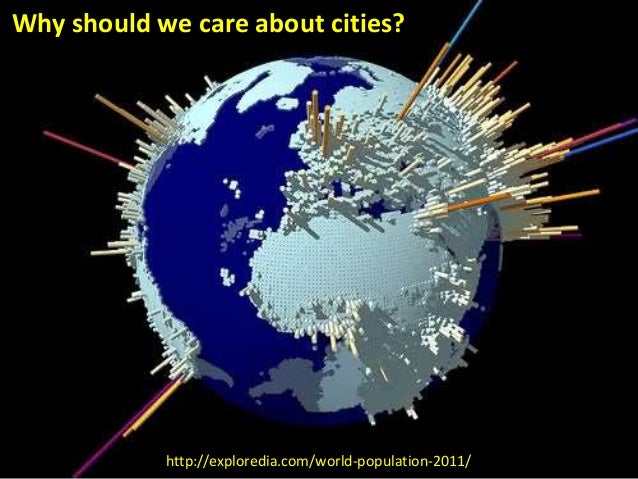
http://exploredia.com/world-population-2011/ Why should we care about
cities?
3. 3.
<https://image.slidesharecdn.com/urbanecology18slideshare-180220033139/95/urban-ecology-3-638.jpg?cb=1519097575>
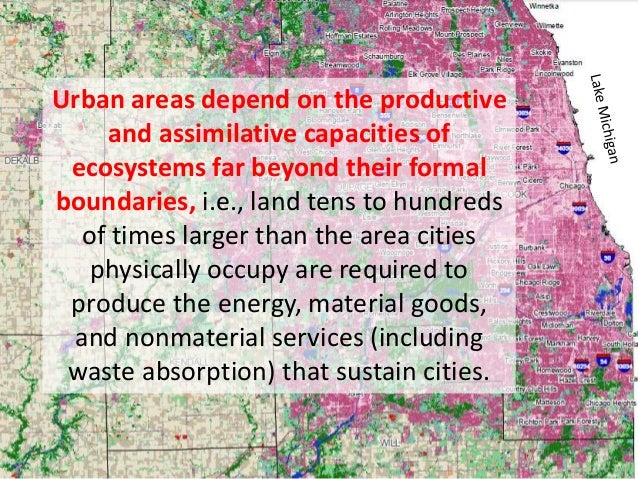
Urban areas depend on the productive and assimilative capacities of
ecosystems far beyond their formal boundaries, i.e., land tens to hundreds
of times larger than the area cities physically occupy are required to
produce the energy, material goods, and nonmaterial services (including
waste absorption) that sustain cities.
4. 4.
<https://image.slidesharecdn.com/urbanecology18slideshare-180220033139/95/urban-ecology-4-638.jpg?cb=1519097575>
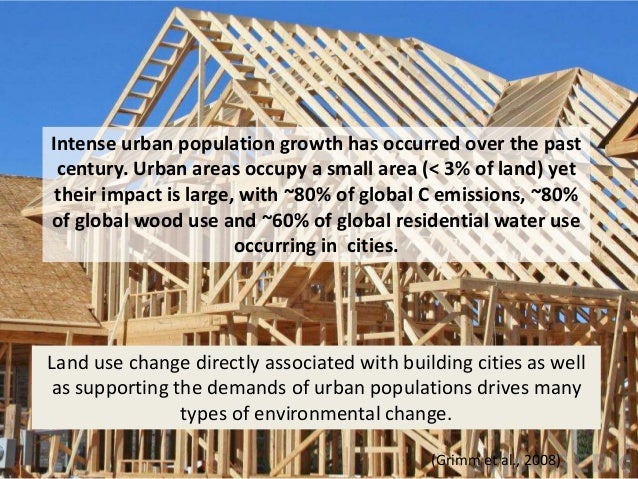
Intense urban population growth has occurred over the past century. Urban
areas occupy a small area (< 3% of land) yet their impact is large, with
~80% of global C emissions, ~80% of global wood use and ~60% of global
residential water use occurring in cities. (Grimm et al., 2008) Land use
change directly associated with building cities as well as supporting the
demands of urban populations drives many types of environmental change.
5. 5.
<https://image.slidesharecdn.com/urbanecology18slideshare-180220033139/95/urban-ecology-5-638.jpg?cb=1519097575>

Some people have lived in cities for a long time but most people have NOT
lived in cities. Do you recognize any of these famous ancient cities?
Ayutthaya (Thailand)Machu Pichu (Peru) Anthens (Greece) Cahokia (USA)
6. 6.
<https://image.slidesharecdn.com/urbanecology18slideshare-180220033139/95/urban-ecology-6-638.jpg?cb=1519097575>
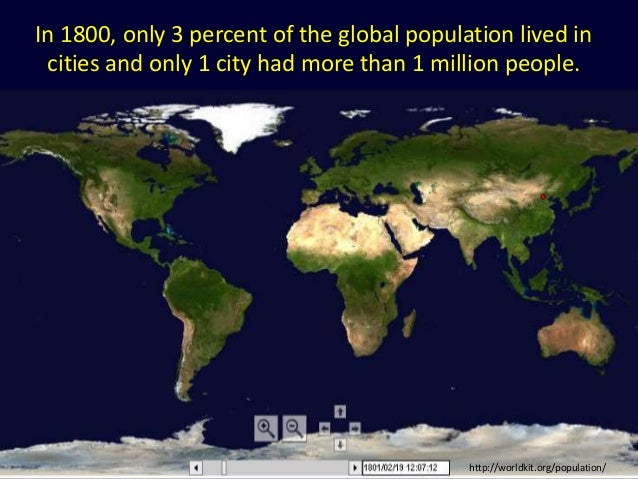
In 1800, only 3 percent of the global population lived in cities and only 1
city had more than 1 million people. http://worldkit.org/population/
7. 7.
<https://image.slidesharecdn.com/urbanecology18slideshare-180220033139/95/urban-ecology-7-638.jpg?cb=1519097575>
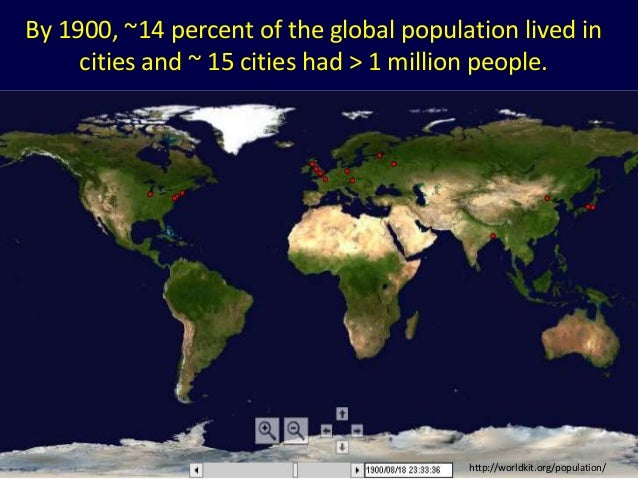
http://worldkit.org/population/ By 1900, ~14 percent of the global
population lived in cities and ~ 15 cities had > 1 million people.
8. 8.
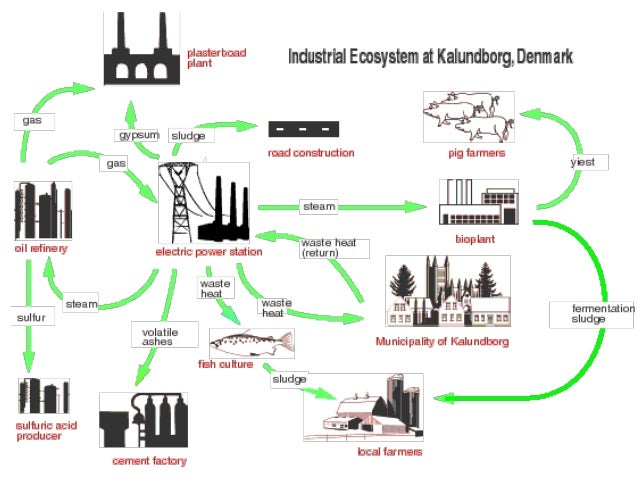
<https://image.slidesharecdn.com/urbanecology18slideshare-180220033139/95/urban-ecology-8-638.jpg?cb=1519097575>
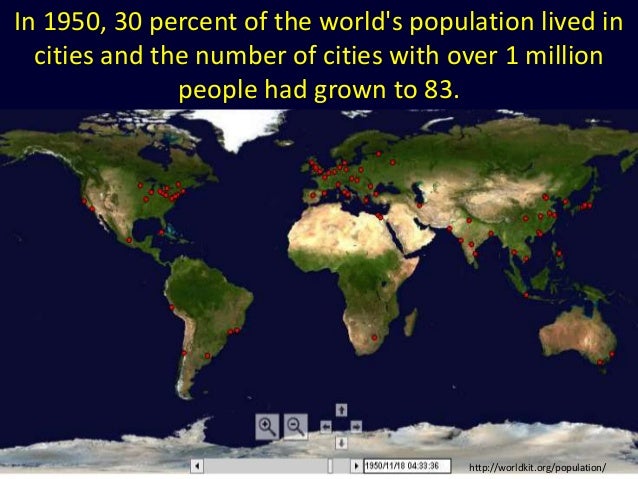
In 1950, 30 percent of the world's population lived in cities and the
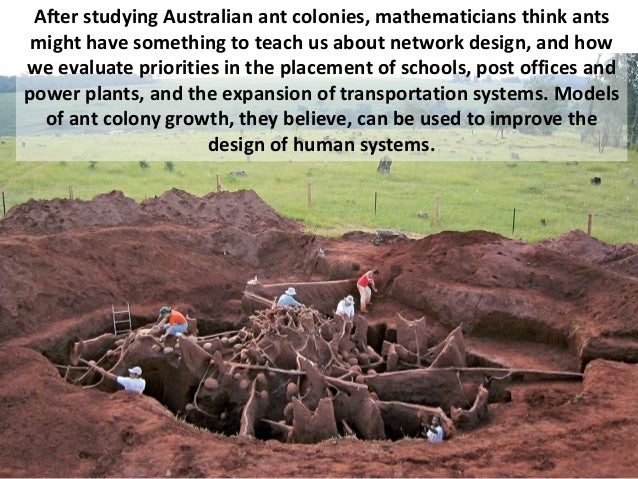
number of cities with over 1 million people had grown to 83.
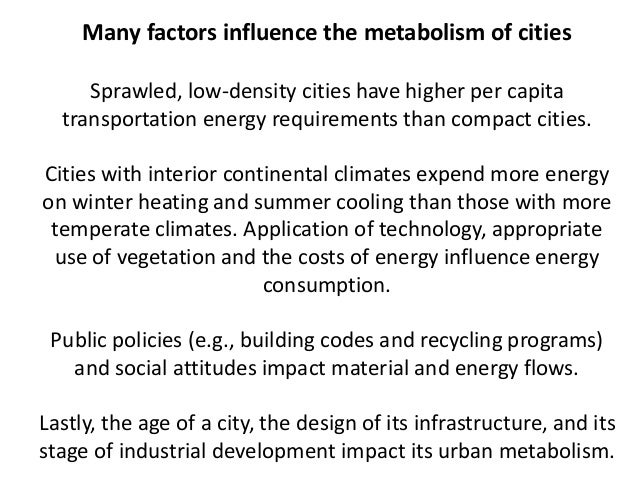
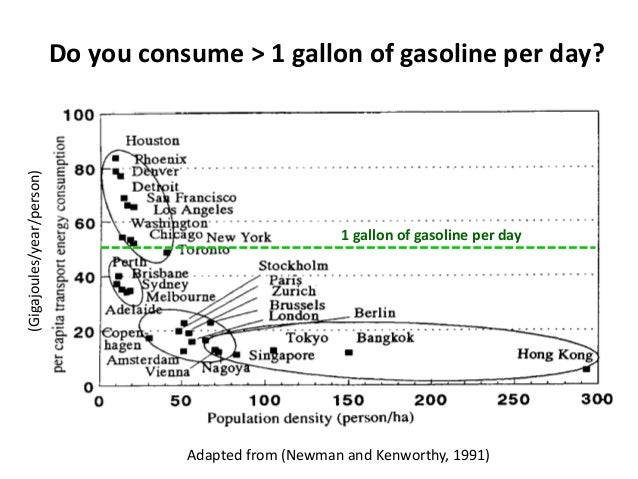
http://worldkit.org/population/
9. 9.
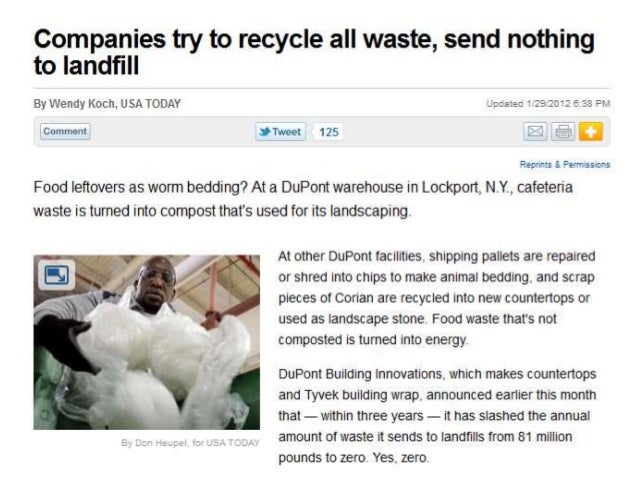
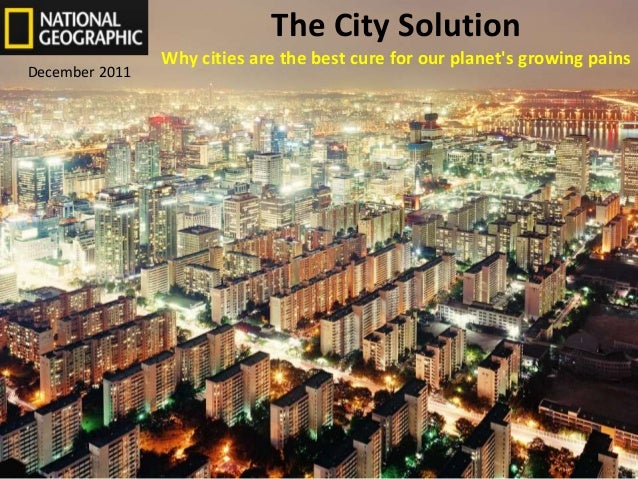
<https://image.slidesharecdn.com/urbanecology18slideshare-180220033139/95/urban-ecology-9-638.jpg?cb=1519097575>
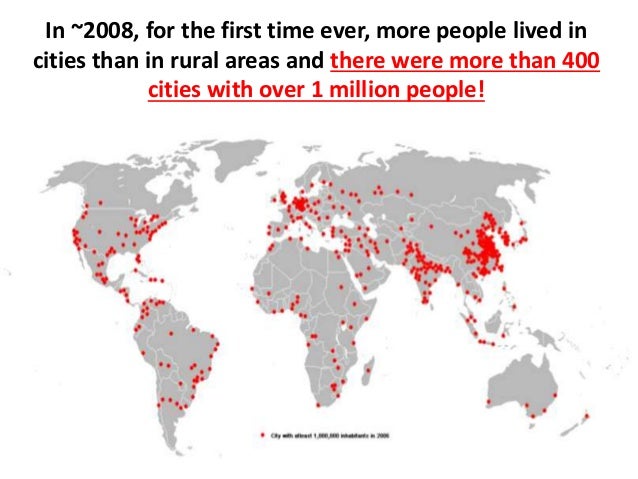
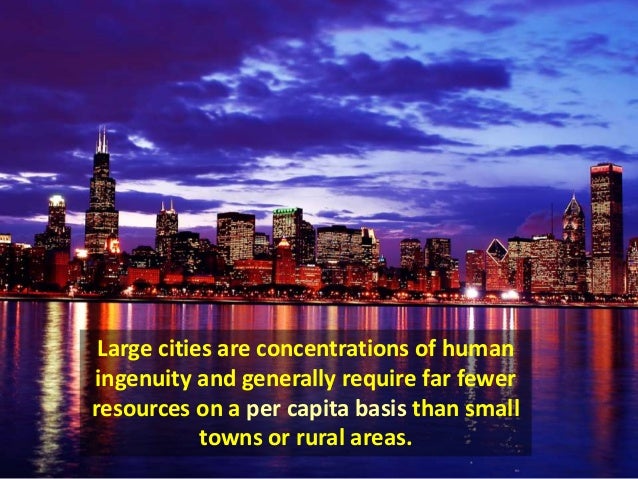
In ~2008, for the first time ever, more people lived in cities than in
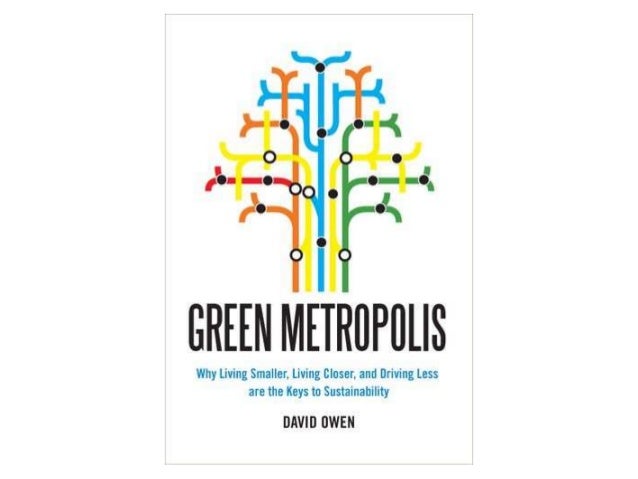
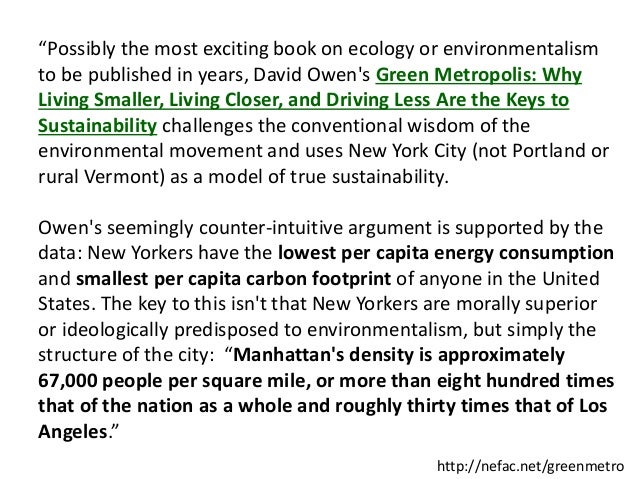
rural areas and there were more than 400 cities with over 1 million people!
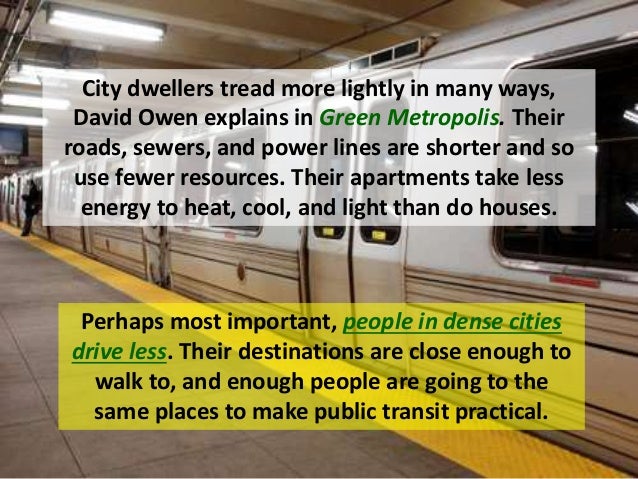
10. 10.
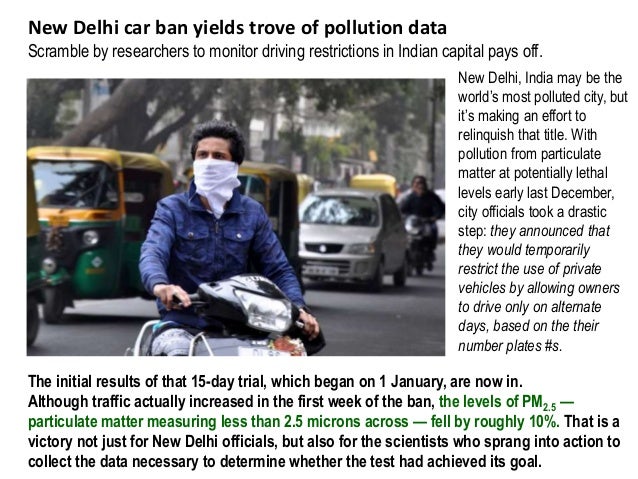
<https://image.slidesharecdn.com/urbanecology18slideshare-180220033139/95/urban-ecology-10-638.jpg?cb=1519097575>
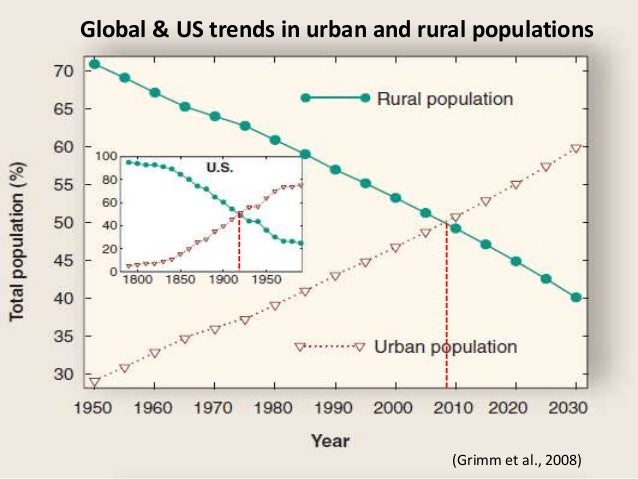
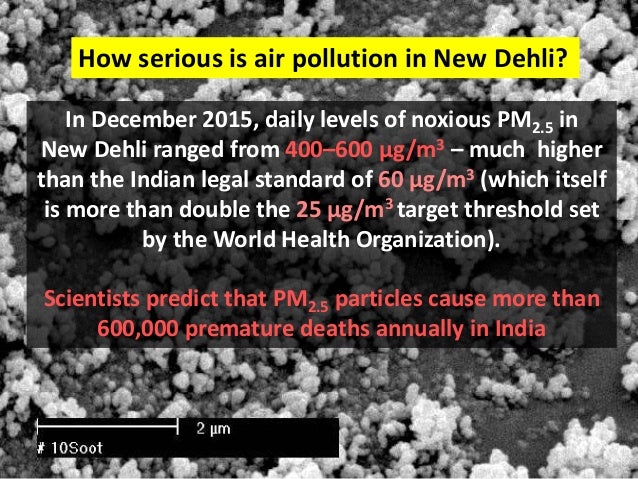
(Grimm et al., 2008) Global & US trends in urban and rural populations
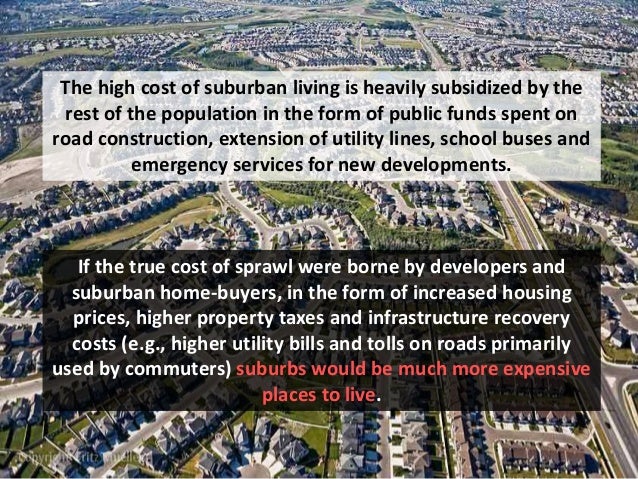
11. 11.
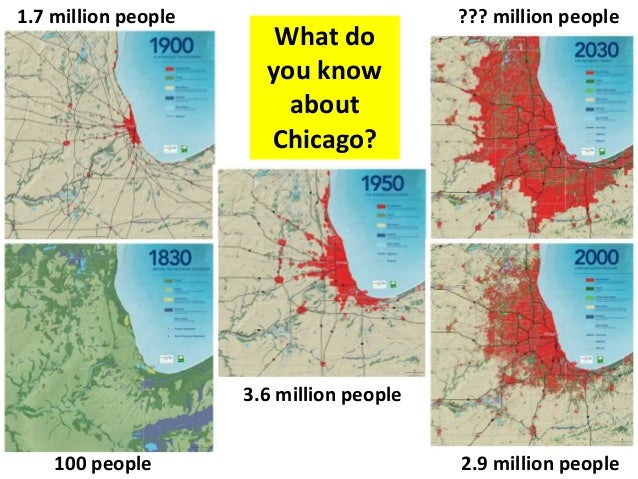
<https://image.slidesharecdn.com/urbanecology18slideshare-180220033139/95/urban-ecology-11-638.jpg?cb=1519097575>
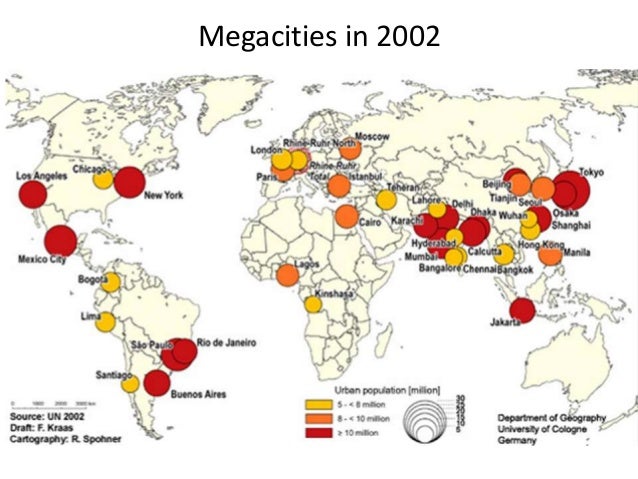
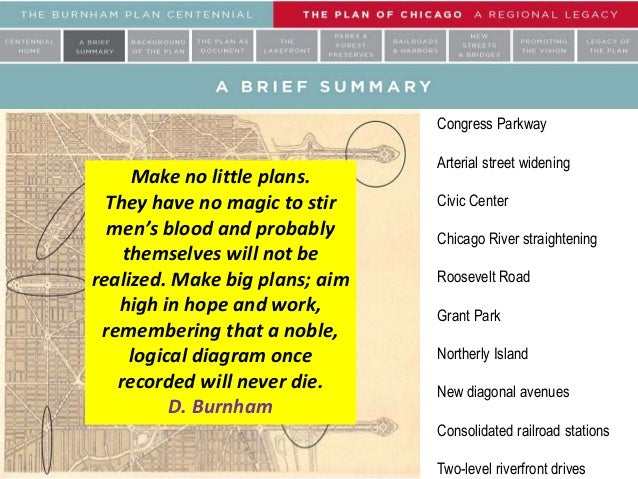
Megacities in 2002
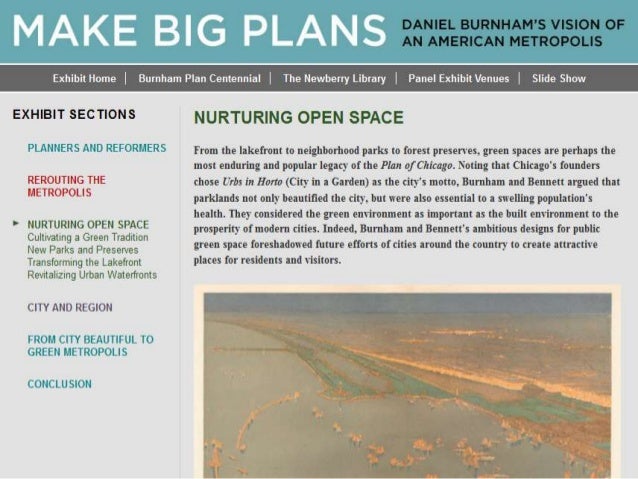
12. 12.
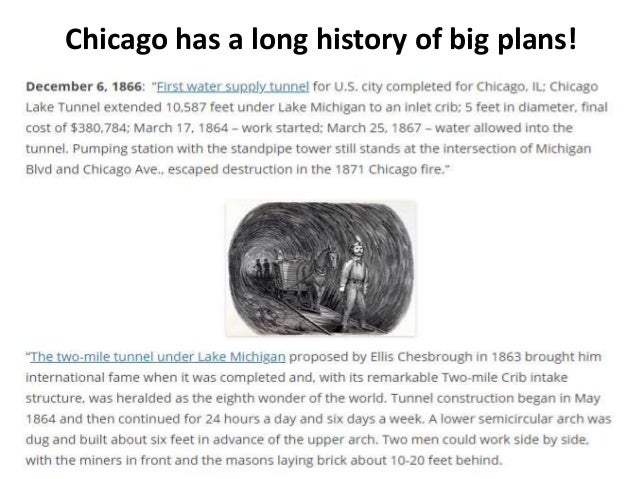
<https://image.slidesharecdn.com/urbanecology18slideshare-180220033139/95/urban-ecology-12-638.jpg?cb=1519097575>
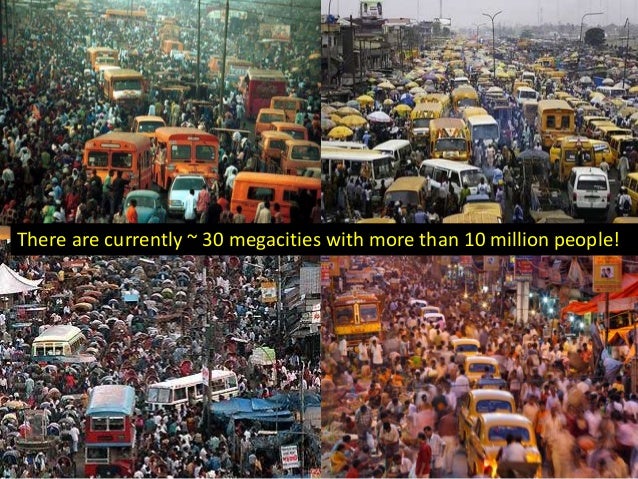
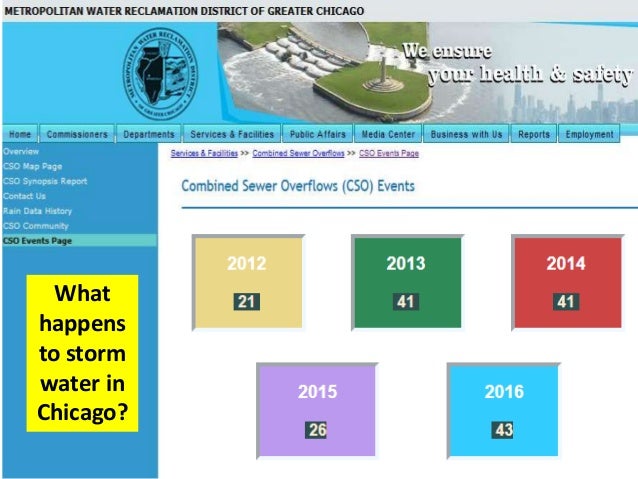
There are currently ~ 30 megacities with more than 10 million people!
13. 13.
<https://image.slidesharecdn.com/urbanecology18slideshare-180220033139/95/urban-ecology-13-638.jpg?cb=1519097575>
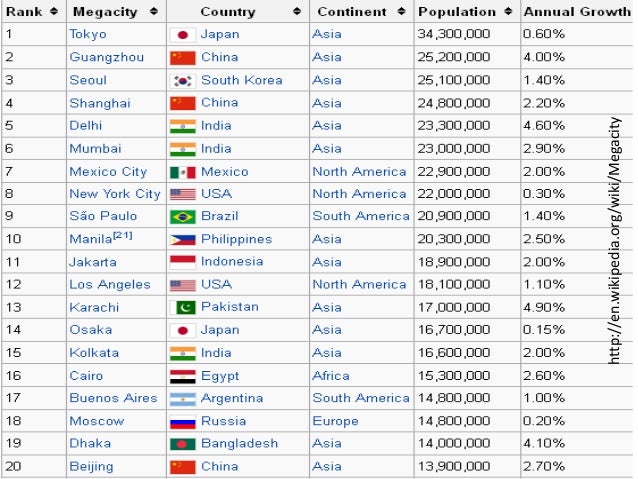
http://en.wikipedia.org/wiki/Megacity
14. 14.
<https://image.slidesharecdn.com/urbanecology18slideshare-180220033139/95/urban-ecology-14-638.jpg?cb=1519097575>
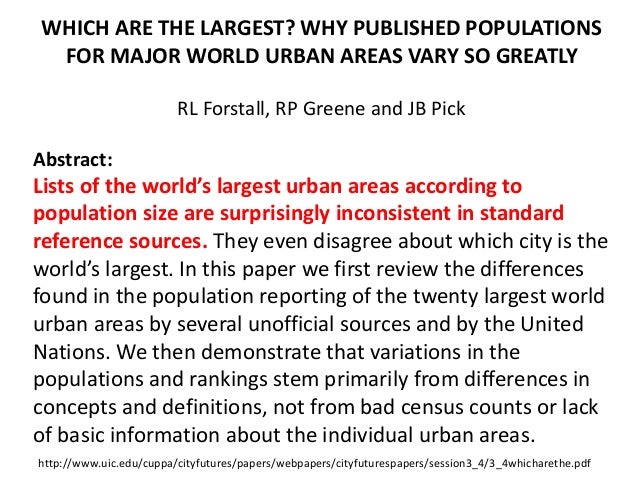
WHICH ARE THE LARGEST? WHY PUBLISHED POPULATIONS FOR MAJOR WORLD URBAN
AREAS VARY SO GREATLY RL Forstall, RP Greene and JB Pick Abstract: Lists of
the world’s largest urban areas according to population size are
surprisingly inconsistent in standard reference sources. They even disagree
about which city is the world’s largest. In this paper we first review the
differences found in the population reporting of the twenty largest world
urban areas by several unofficial sources and by the United Nations. We
then demonstrate that variations in the populations and rankings stem
primarily from differences in concepts and definitions, not from bad census
counts or lack of basic information about the individual urban areas.
http://www.uic.edu/cuppa/cityfutures/papers/webpapers/cityfuturespapers/session3_4/3_4whicharethe.pdf
15. 15.
<https://image.slidesharecdn.com/urbanecology18slideshare-180220033139/95/urban-ecology-15-638.jpg?cb=1519097575>
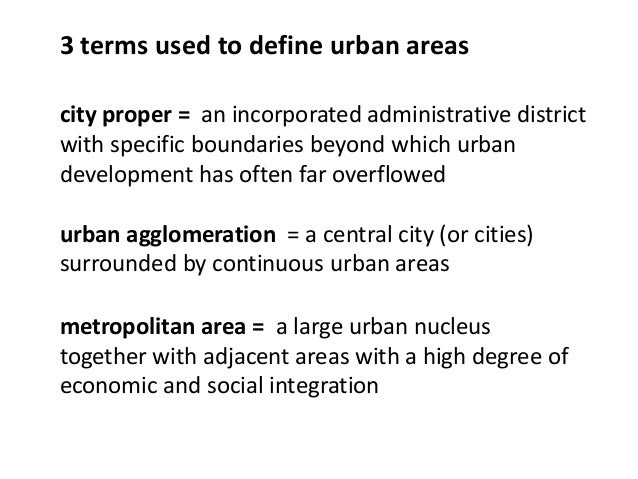
metropolitan area = a large urban nucleus together with adjacent areas with
a high degree of economic and social integration city proper = an
incorporated administrative district with specific boundaries beyond which
urban development has often far overflowed 3 terms used to define urban
areas urban agglomeration = a central city (or cities) surrounded by
continuous urban areas
16. 16.
<https://image.slidesharecdn.com/urbanecology18slideshare-180220033139/95/urban-ecology-16-638.jpg?cb=1519097575>
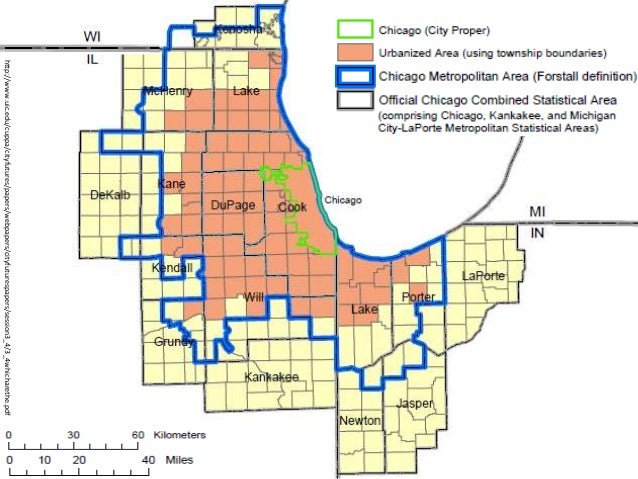
http://www.uic.edu/cuppa/cityfutures/papers/webpapers/cityfuturespapers/session3_4/3_4whicharethe.pdf
17. 17.
<https://image.slidesharecdn.com/urbanecology18slideshare-180220033139/95/urban-ecology-17-638.jpg?cb=1519097575>
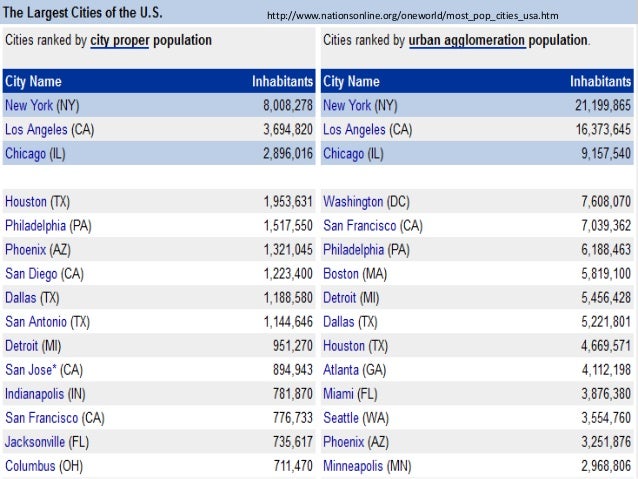
http://www.nationsonline.org/oneworld/most_pop_cities_usa.htm
18. 18.
<https://image.slidesharecdn.com/urbanecology18slideshare-180220033139/95/urban-ecology-18-638.jpg?cb=1519097575>
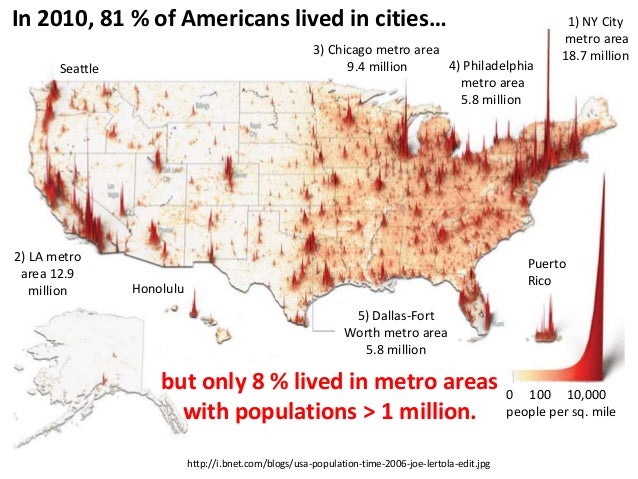
Seattle 3) Chicago metro area 9.4 million 4) Philadelphia metro area 5.8
million 1) NY City metro area 18.7 million 5) Dallas-Fort Worth metro area
5.8 million 2) LA metro area 12.9 million Honolulu Puerto Rico but only 8 %
lived in metro areas with populations > 1 million. 0 100 10,000 people per
sq. mile
http://i.bnet.com/blogs/usa-population-time-2006-joe-lertola-edit.jpg In

2010, 81 % of Americans lived in cities…
19. 19.
<https://image.slidesharecdn.com/urbanecology18slideshare-180220033139/95/urban-ecology-19-638.jpg?cb=1519097575>
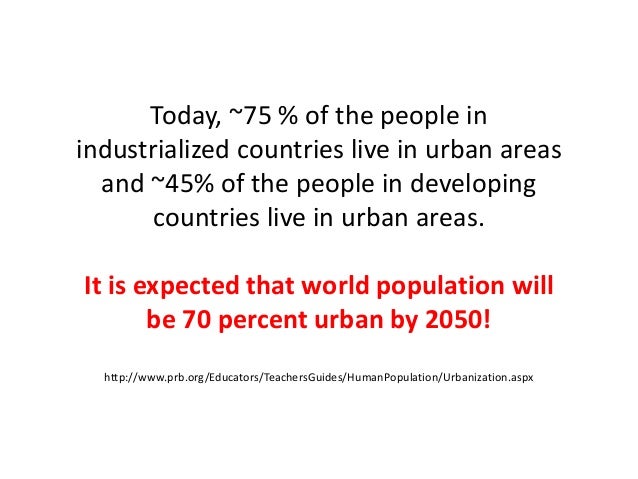
Today, ~75 % of the people in industrialized countries live in urban areas
and ~45% of the people in developing countries live in urban areas. It is
expected that world population will be 70 percent urban by 2050!
http://www.prb.org/Educators/TeachersGuides/HumanPopulation/Urbanization.aspx
20. 20.
<https://image.slidesharecdn.com/urbanecology18slideshare-180220033139/95/urban-ecology-20-638.jpg?cb=1519097575>
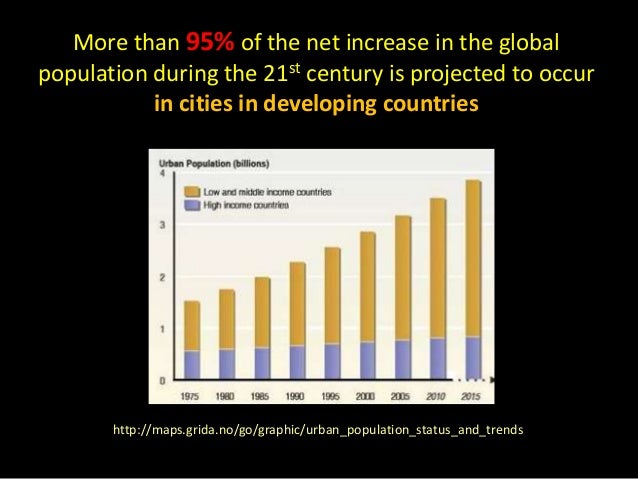
More than 95% of the net increase in the global population during the 21st
century is projected to occur in cities in developing countries
http://maps.grida.no/go/graphic/urban_population_status_and_trends
21. 21.
<https://image.slidesharecdn.com/urbanecology18slideshare-180220033139/95/urban-ecology-21-638.jpg?cb=1519097575>
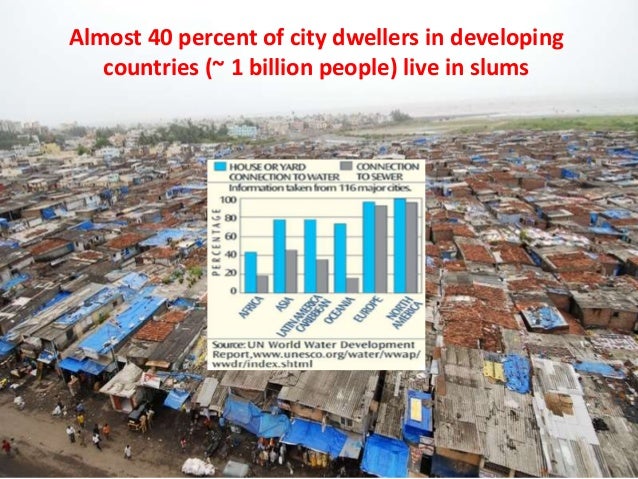
Almost 40 percent of city dwellers in developing countries (~ 1 billion
people) live in slums
22. 22.
<https://image.slidesharecdn.com/urbanecology18slideshare-180220033139/95/urban-ecology-22-638.jpg?cb=1519097575>
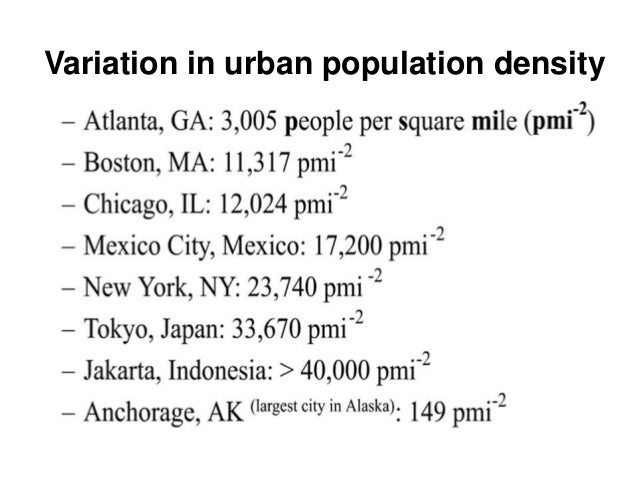
Variation in urban population density
23. 23.
<https://image.slidesharecdn.com/urbanecology18slideshare-180220033139/95/urban-ecology-23-638.jpg?cb=1519097575>
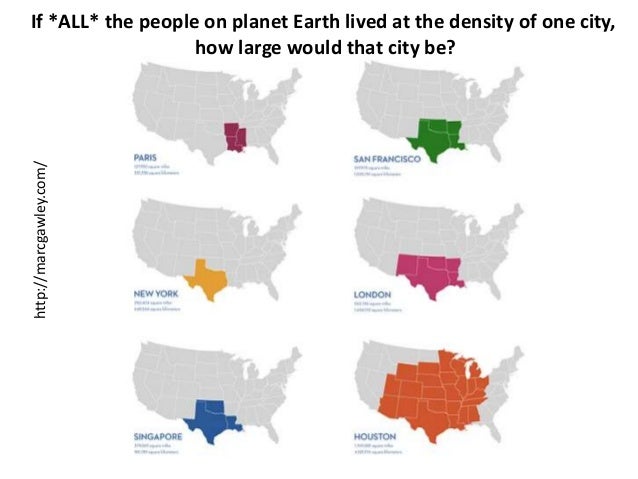
If *ALL* the people on planet Earth lived at the density of one city, how
large would that city be?http://marcgawley.com/
24. 24.
<https://image.slidesharecdn.com/urbanecology18slideshare-180220033139/95/urban-ecology-24-638.jpg?cb=1519097575>
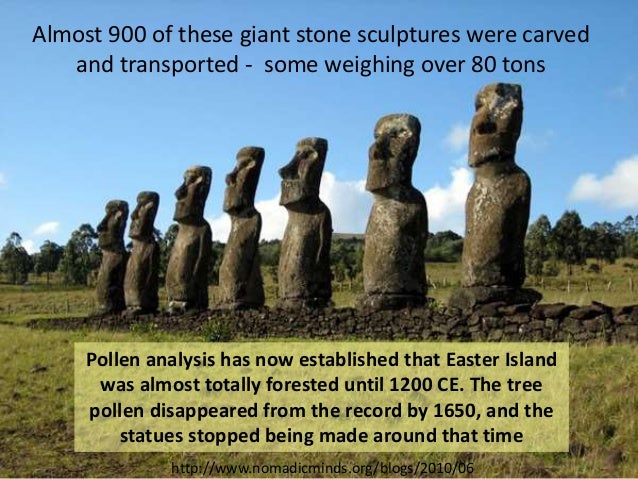
http://www.nomadicminds.org/blogs/2010/06 Pollen analysis has now
established that Easter Island was almost totally forested until 1200 CE.
The tree pollen disappeared from the record by 1650, and the statues
stopped being made around that time Almost 900 of these giant stone
sculptures were carved and transported - some weighing over 80 tons
25. 25.
<https://image.slidesharecdn.com/urbanecology18slideshare-180220033139/95/urban-ecology-25-638.jpg?cb=1519097575>
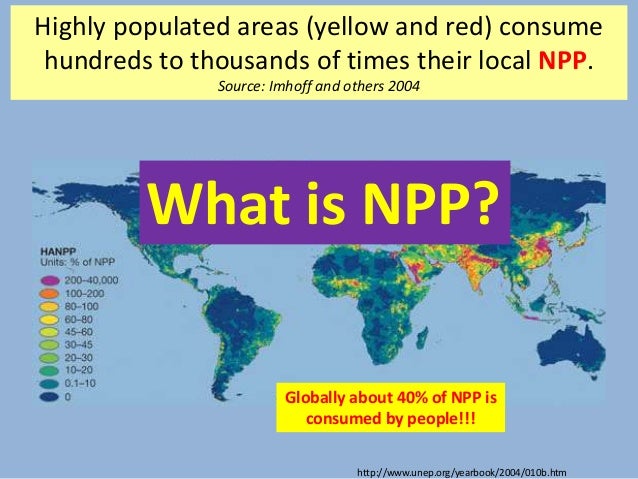
http://www.unep.org/yearbook/2004/010b.htm Highly populated areas
(yellow and red) consume hundreds to thousands of times their local NPP.
Source: Imhoff and others 2004 Globally about 40% of NPP is consumed by
people!!! What is NPP?
26. 26.
<https://image.slidesharecdn.com/urbanecology18slideshare-180220033139/95/urban-ecology-26-638.jpg?cb=1519097575>
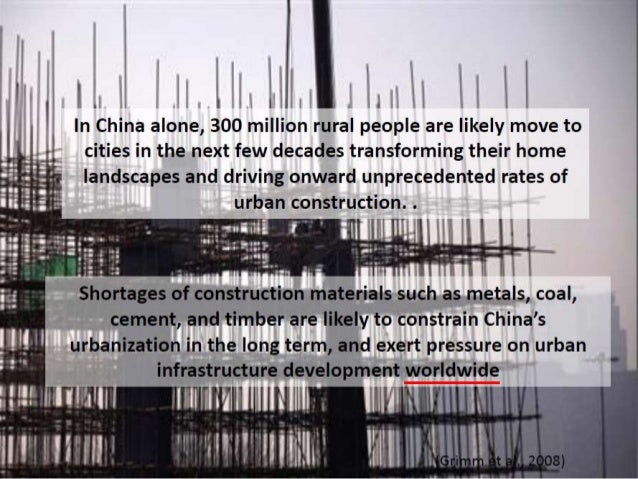
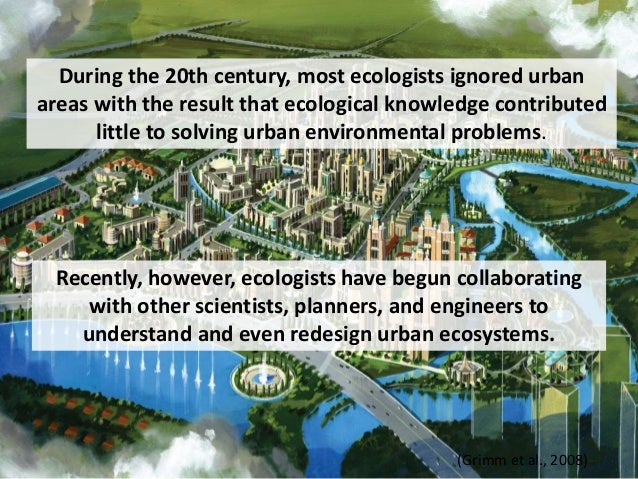
Recently, however, ecologists have begun collaborating with other
scientists, planners, and engineers to understand and even redesign urban
ecosystems. (Grimm et al., 2008) During the 20th century, most ecologists
ignored urban areas with the result that ecological knowledge contributed
little to solving urban environmental problems.
27. 27.
<https://image.slidesharecdn.com/urbanecology18slideshare-180220033139/95/urban-ecology-27-638.jpg?cb=1519097575>

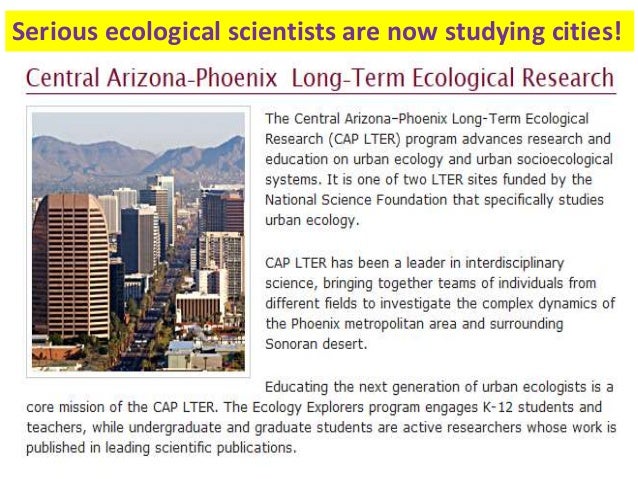
Serious ecological scientists are now studying cities!
28. 28.
<https://image.slidesharecdn.com/urbanecology18slideshare-180220033139/95/urban-ecology-28-638.jpg?cb=1519097575>
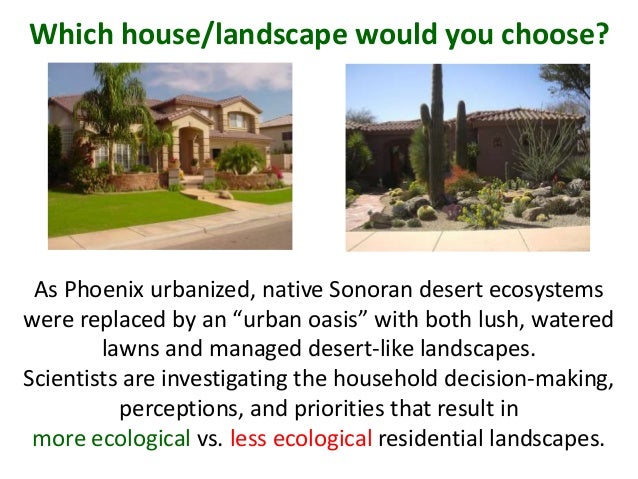
As Phoenix urbanized, native Sonoran desert ecosystems were replaced by an
“urban oasis” with both lush, watered lawns and managed desert-like
landscapes. Scientists are investigating the household decision-making,
perceptions, and priorities that result in more ecological vs. less
ecological residential landscapes. Which house/landscape would you choose?
29. 29.
<https://image.slidesharecdn.com/urbanecology18slideshare-180220033139/95/urban-ecology-29-638.jpg?cb=1519097575>
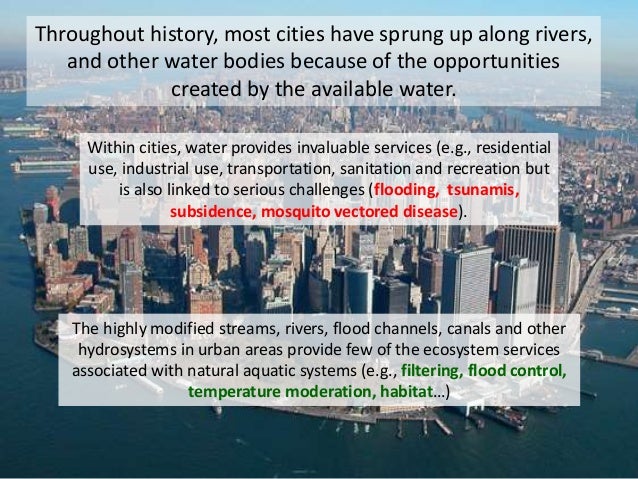
Throughout history, most cities have sprung up along rivers, and other
water bodies because of the opportunities created by the available water.
Within cities, water provides invaluable services (e.g., residential use,
industrial use, transportation, sanitation and recreation but is also
linked to serious challenges (flooding, tsunamis, subsidence, mosquito
vectored disease). The highly modified streams, rivers, flood channels,
canals and other hydrosystems in urban areas provide few of the ecosystem
services associated with natural aquatic systems (e.g., filtering, flood
control, temperature moderation, habitat…)
30. 30.
<https://image.slidesharecdn.com/urbanecology18slideshare-180220033139/95/urban-ecology-30-638.jpg?cb=1519097575>
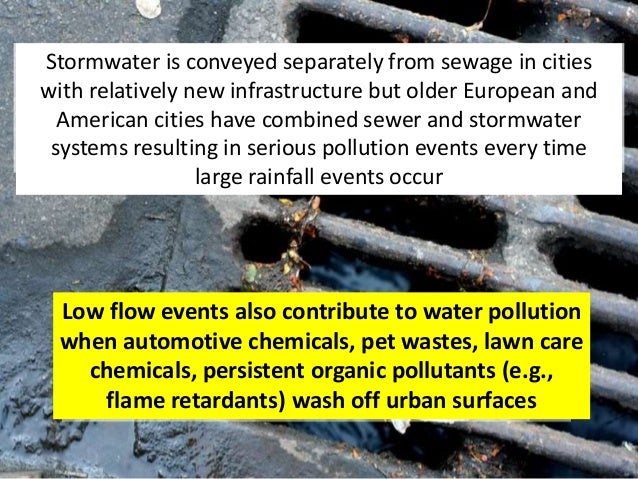
Low flow events also contribute to water pollution when automotive
chemicals, pet wastes, lawn care chemicals, persistent organic pollutants
(e.g., flame retardants) wash off urban surfaces Stormwater is conveyed
separately from sewage in cities with relatively new infrastructure but
older European and American cities have combined sewer and stormwater
systems resulting in serious pollution events every time large rainfall
events occur
31. 31.
<https://image.slidesharecdn.com/urbanecology18slideshare-180220033139/95/urban-ecology-31-638.jpg?cb=1519097575>
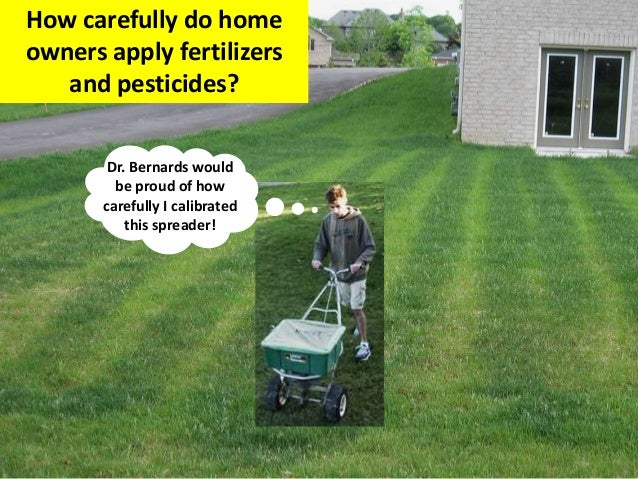
How carefully do home owners apply fertilizers and pesticides? Dr. Bernards
would be proud of how carefully I calibrated this spreader!
32. 32.
<https://image.slidesharecdn.com/urbanecology18slideshare-180220033139/95/urban-ecology-32-638.jpg?cb=1519097575>
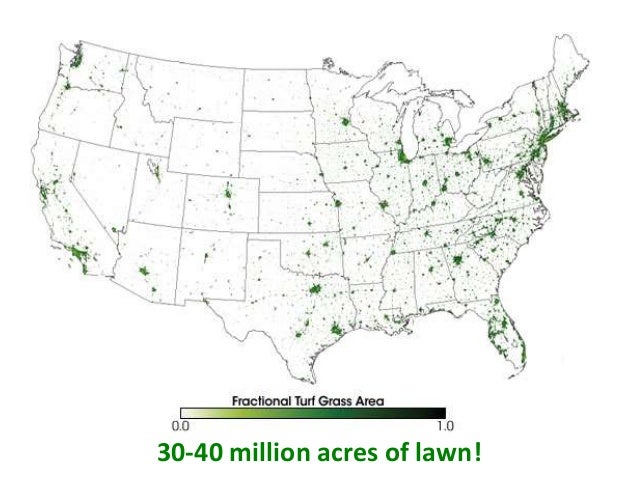
30-40 million acres of lawn!
33. 33.
<https://image.slidesharecdn.com/urbanecology18slideshare-180220033139/95/urban-ecology-33-638.jpg?cb=1519097575>
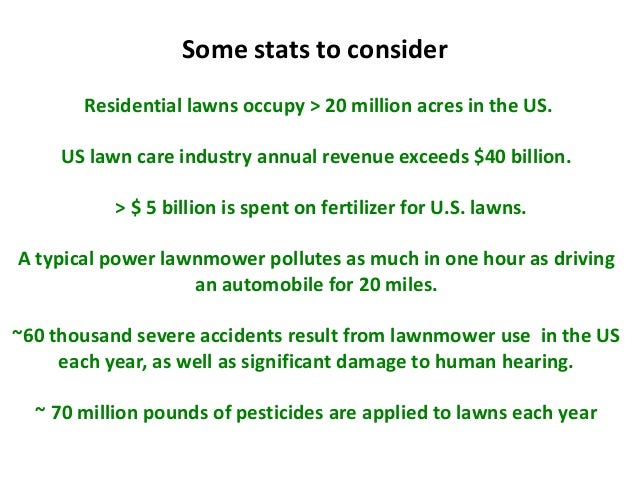
Residential lawns occupy > 20 million acres in the US. US lawn care
industry annual revenue exceeds $40 billion. > $ 5 billion is spent on
fertilizer for U.S. lawns. A typical power lawnmower pollutes as much in
one hour as driving an automobile for 20 miles. ~60 thousand severe
accidents result from lawnmower use in the US each year, as well as
significant damage to human hearing. ~ 70 million pounds of pesticides are
applied to lawns each year Some stats to consider
34. 34.
<https://image.slidesharecdn.com/urbanecology18slideshare-180220033139/95/urban-ecology-34-638.jpg?cb=1519097575>
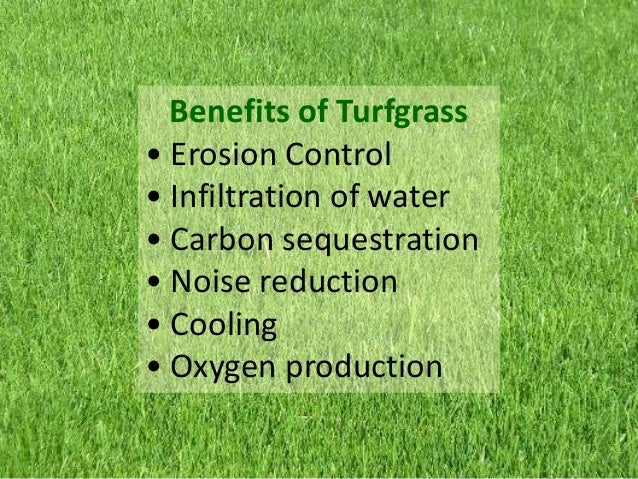
Benefits of Turfgrass • Erosion Control • Infiltration of water • Carbon
sequestration • Noise reduction • Cooling • Oxygen production
35. 35.
<https://image.slidesharecdn.com/urbanecology18slideshare-180220033139/95/urban-ecology-35-638.jpg?cb=1519097575>
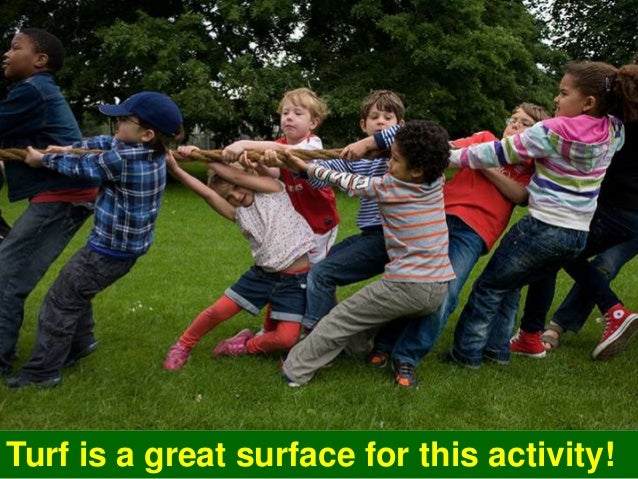
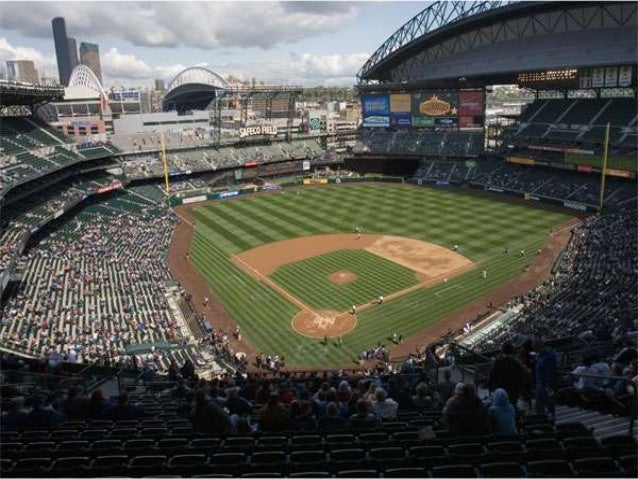
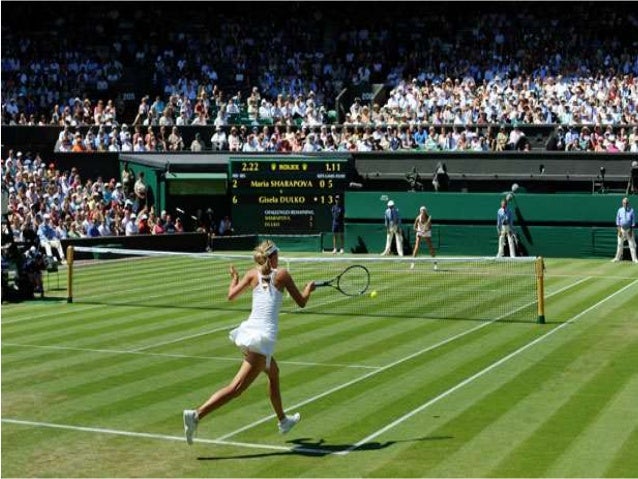
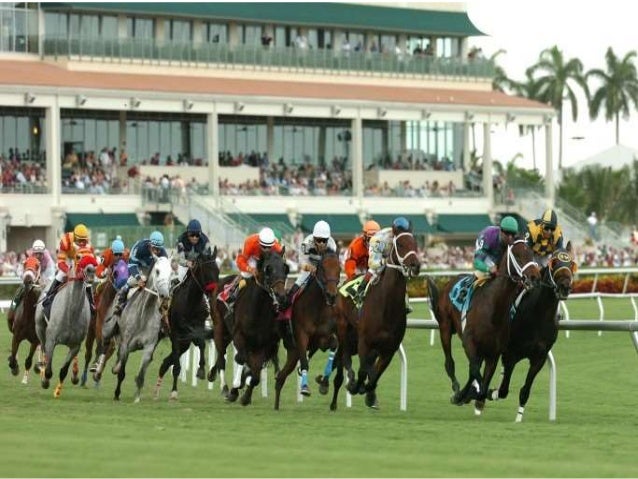
Turf is a great surface for this activity!
36. 36.
<https://image.slidesharecdn.com/urbanecology18slideshare-180220033139/95/urban-ecology-36-638.jpg?cb=1519097575>
Fun at the Farm!
37. 37.
<https://image.slidesharecdn.com/urbanecology18slideshare-180220033139/95/urban-ecology-37-638.jpg?cb=1519097575>
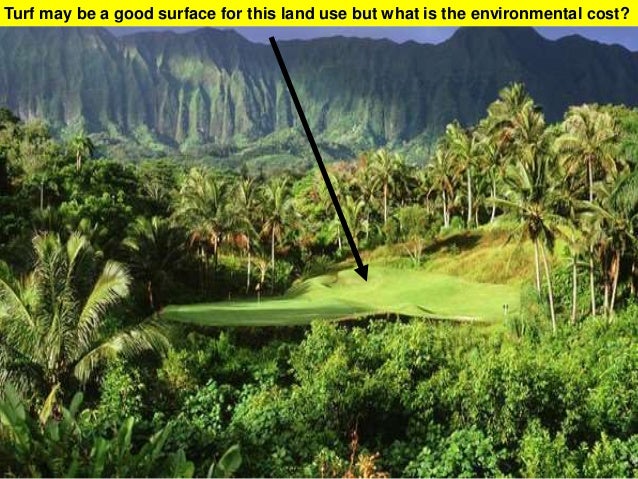
Turf may be a good surface for this land use but what is the environmental
cost?
38. 38.
<https://image.slidesharecdn.com/urbanecology18slideshare-180220033139/95/urban-ecology-38-638.jpg?cb=1519097575>
Crocodile tourism might be a better land use
39. 39.
<https://image.slidesharecdn.com/urbanecology18slideshare-180220033139/95/urban-ecology-39-638.jpg?cb=1519097575>
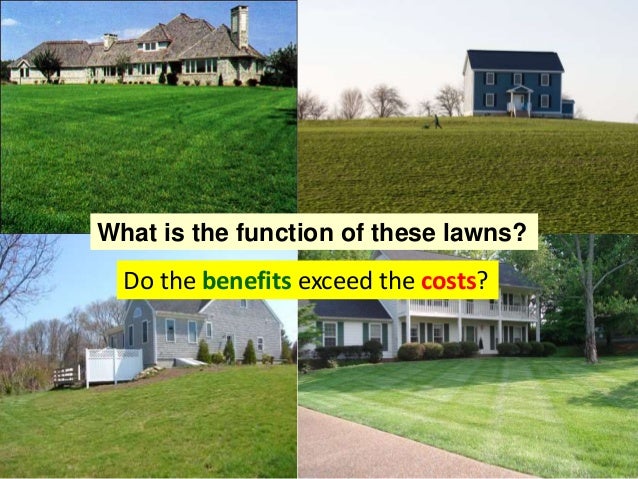
What is the function of these lawns? Do the benefits exceed the costs?
40. 40.
<https://image.slidesharecdn.com/urbanecology18slideshare-180220033139/95/urban-ecology-40-638.jpg?cb=1519097575>

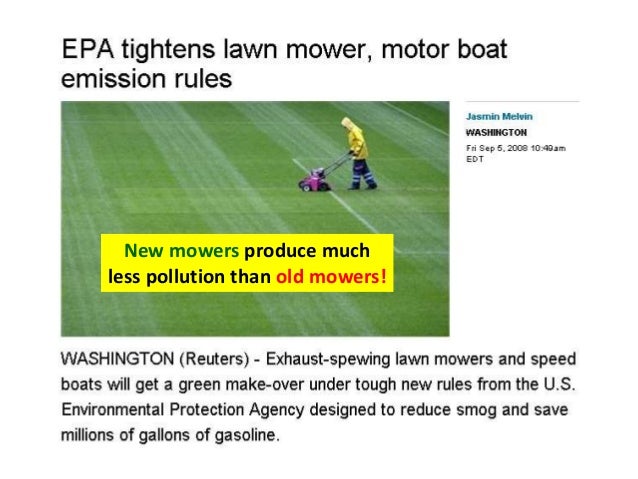
New mowers produce much less pollution than old mowers!
41. 41.
<https://image.slidesharecdn.com/urbanecology18slideshare-180220033139/95/urban-ecology-41-638.jpg?cb=1519097575>
Midwest states many spend $$$ mowing thousands of acres of roadside turf.
42. 42.
<https://image.slidesharecdn.com/urbanecology18slideshare-180220033139/95/urban-ecology-42-638.jpg?cb=1519097575>
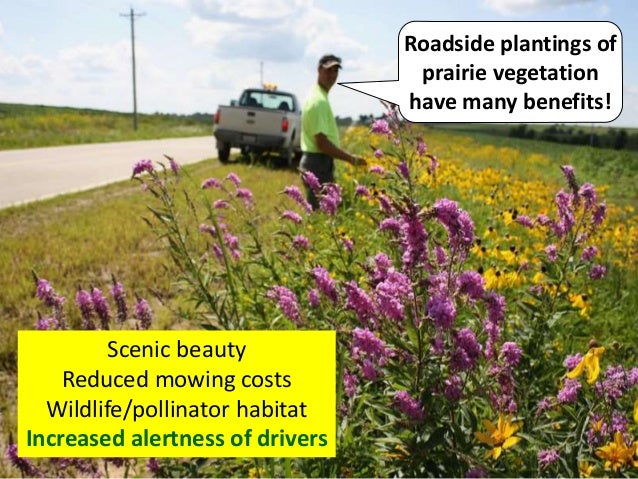
Scenic beauty Reduced mowing costs Wildlife/pollinator habitat Increased
alertness of drivers Roadside plantings of prairie vegetation have many
benefits!
43. 43.
<https://image.slidesharecdn.com/urbanecology18slideshare-180220033139/95/urban-ecology-43-638.jpg?cb=1519097575>
INTRODUCTION The Illinois Department of Transportation (IDOT) has been
interested in mapping roadside prairie since 1992. A formal request was
made in 1998 by Rich Nowack to map prairie while traveling to other IDOT
project areas, and as time allowed. IDOT’s justification for this project
was to preserve prairie habitat, and limit accidental mowing and herbicide
spraying of native prairie remnants. In 2000, IDOT made this project a
priority. In the 2001 field season, a more detailed and systematic approach
was taken to survey prairies in Illinois. This report and final GIS map is
the result of the information gathered during the 2003 field season in IDOT
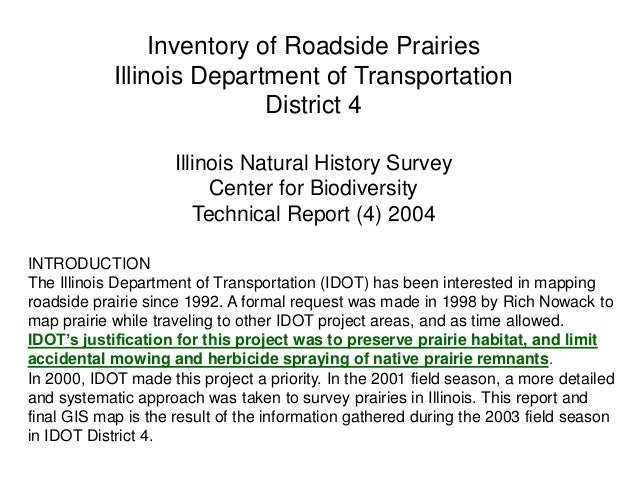
District 4. Inventory of Roadside Prairies Illinois Department of
Transportation District 4 Illinois Natural History Survey Center for
Biodiversity Technical Report (4) 2004
44. 44.
<https://image.slidesharecdn.com/urbanecology18slideshare-180220033139/95/urban-ecology-44-638.jpg?cb=1519097575>
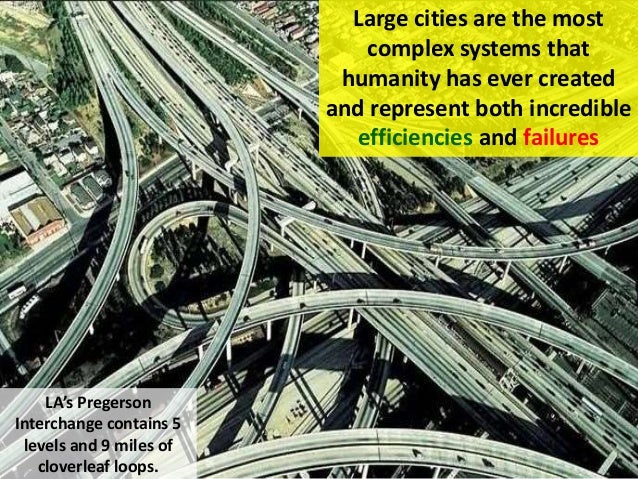
Large cities are the most complex systems that humanity has ever created
and represent both incredible efficiencies and failures LA’s Pregerson
Interchange contains 5 levels and 9 miles of cloverleaf loops.
45. 45.
<https://image.slidesharecdn.com/urbanecology18slideshare-180220033139/95/urban-ecology-45-638.jpg?cb=1519097575>

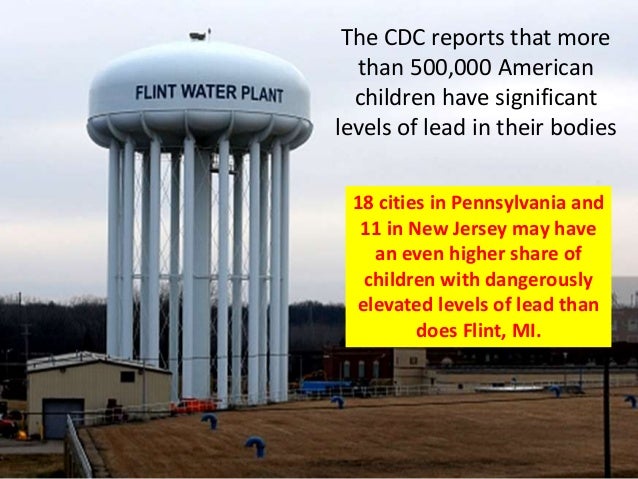
The CDC reports that more than 500,000 American children have significant
levels of lead in their bodies 18 cities in Pennsylvania and 11 in New
Jersey may have an even higher share of children with dangerously elevated
levels of lead than does Flint, MI.
46. 46.
<https://image.slidesharecdn.com/urbanecology18slideshare-180220033139/95/urban-ecology-46-638.jpg?cb=1519097575>
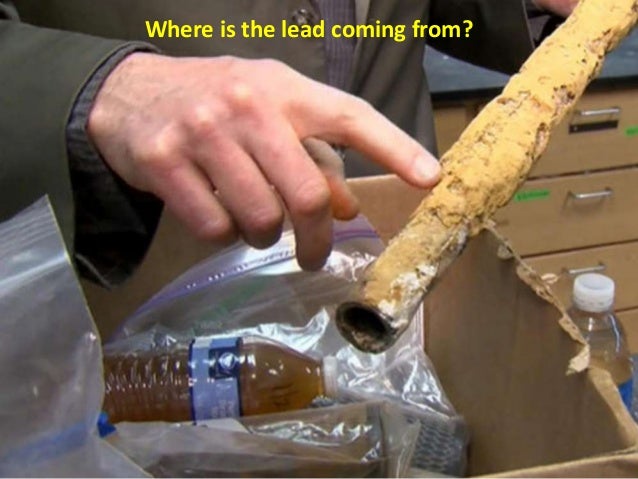
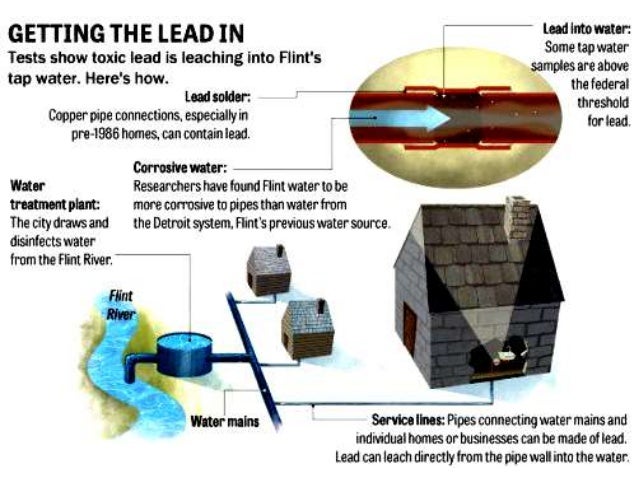
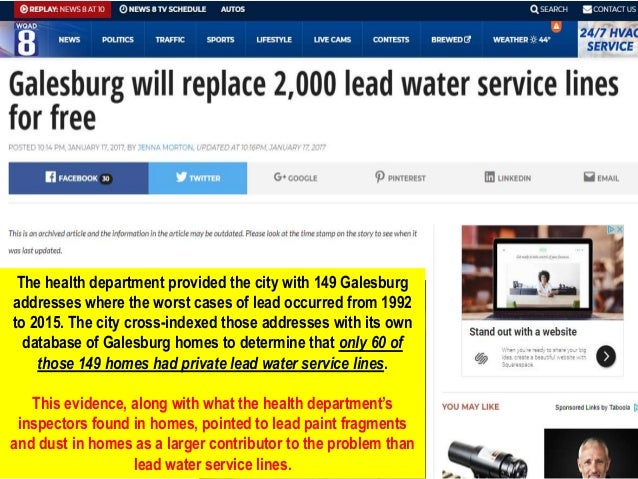
Where is the lead coming from?
47. 47.
<https://image.slidesharecdn.com/urbanecology18slideshare-180220033139/95/urban-ecology-47-638.jpg?cb=1519097575>
The health department provided the city with 149 Galesburg addresses where
the worst cases of lead occurred from 1992 to 2015. The city cross-indexed
those addresses with its own database of Galesburg homes to determine that
only 60 of those 149 homes had private lead water service lines. This
evidence, along with what the health department’s inspectors found in
homes, pointed to lead paint fragments and dust in homes as a larger
contributor to the problem than lead water service lines.
48. 48.
<https://image.slidesharecdn.com/urbanecology18slideshare-180220033139/95/urban-ecology-48-638.jpg?cb=1519097575>

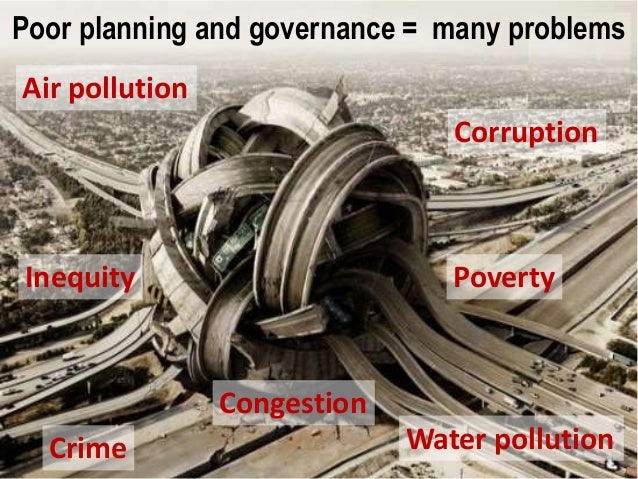
Poor planning and governance = many problems Crime Congestion Air pollution
Water pollution Poverty Corruption Inequity
49. 49.
<https://image.slidesharecdn.com/urbanecology18slideshare-180220033139/95/urban-ecology-49-638.jpg?cb=1519097575>
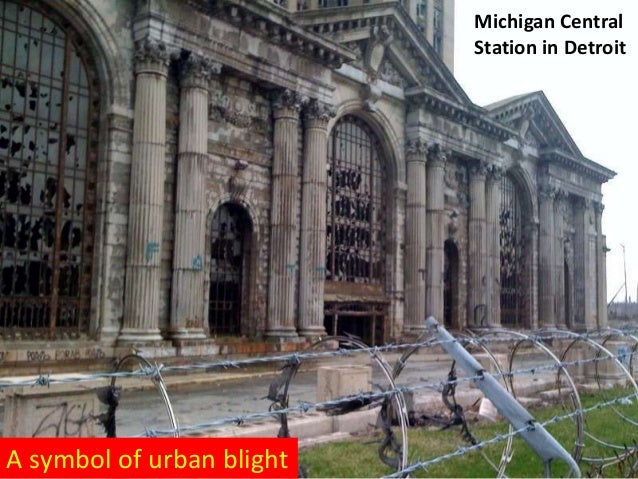
Michigan Central Station in Detroit A symbol of urban blight
50. 50.
<https://image.slidesharecdn.com/urbanecology18slideshare-180220033139/95/urban-ecology-50-638.jpg?cb=1519097575>
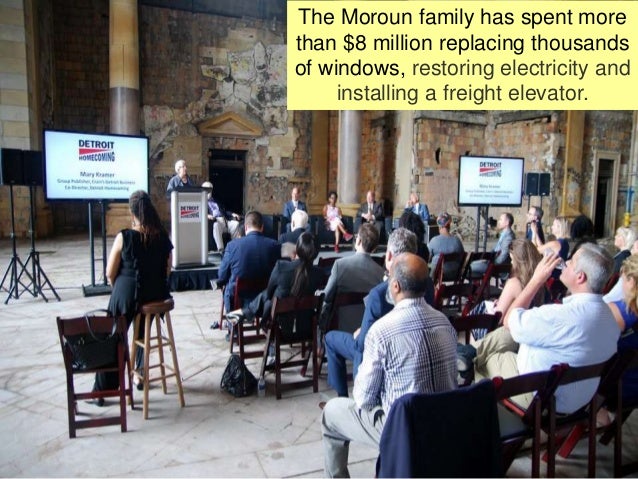
The Moroun family has spent more than $8 million replacing thousands of
windows, restoring electricity and installing a freight elevator.
51. 51.
<https://image.slidesharecdn.com/urbanecology18slideshare-180220033139/95/urban-ecology-51-638.jpg?cb=1519097575>
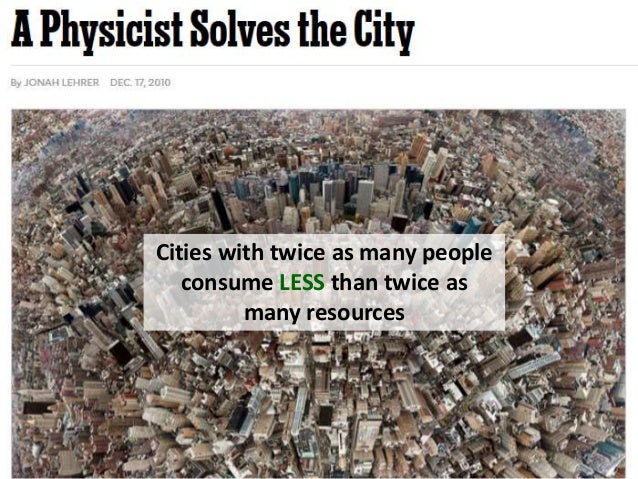
Cities with twice as many people consume LESS than twice as many resources
52. 52.
<https://image.slidesharecdn.com/urbanecology18slideshare-180220033139/95/urban-ecology-52-638.jpg?cb=1519097575>
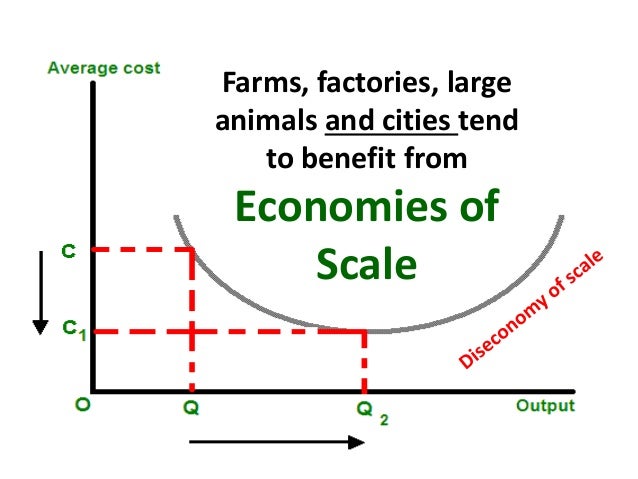
Farms, factories, large animals and cities tend to benefit from Economies
of Scale
53. 53.
<https://image.slidesharecdn.com/urbanecology18slideshare-180220033139/95/urban-ecology-53-638.jpg?cb=1519097575>
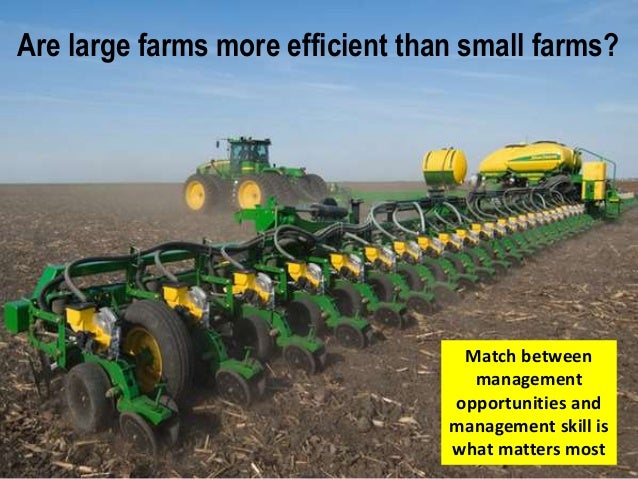
Are large farms more efficient than small farms? Match between management
opportunities and management skill is what matters most
54. 54.
<https://image.slidesharecdn.com/urbanecology18slideshare-180220033139/95/urban-ecology-54-638.jpg?cb=1519097575>
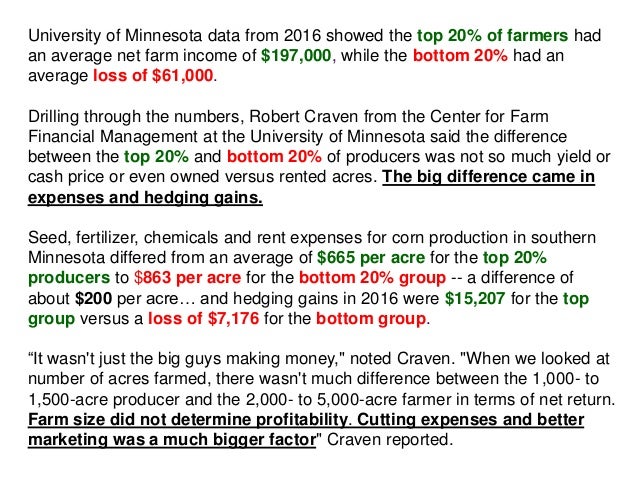
University of Minnesota data from 2016 showed the top 20% of farmers had an
average net farm income of $197,000, while the bottom 20% had an average
loss of $61,000. Drilling through the numbers, Robert Craven from the
Center for Farm Financial Management at the University of Minnesota said
the difference between the top 20% and bottom 20% of producers was not so
much yield or cash price or even owned versus rented acres. The big
difference came in expenses and hedging gains. Seed, fertilizer, chemicals
and rent expenses for corn production in southern Minnesota differed from
an average of $665 per acre for the top 20% producers to $863 per acre for
the bottom 20% group -- a difference of about $200 per acre… and hedging
gains in 2016 were $15,207 for the top group versus a loss of $7,176 for
the bottom group. “It wasn't just the big guys making money," noted Craven.
"When we looked at number of acres farmed, there wasn't much difference
between the 1,000- to 1,500-acre producer and the 2,000- to 5,000-acre
farmer in terms of net return. Farm size did not determine profitability.
Cutting expenses and better marketing was a much bigger factor" Craven
reported.
55. 55.
<https://image.slidesharecdn.com/urbanecology18slideshare-180220033139/95/urban-ecology-55-638.jpg?cb=1519097575>
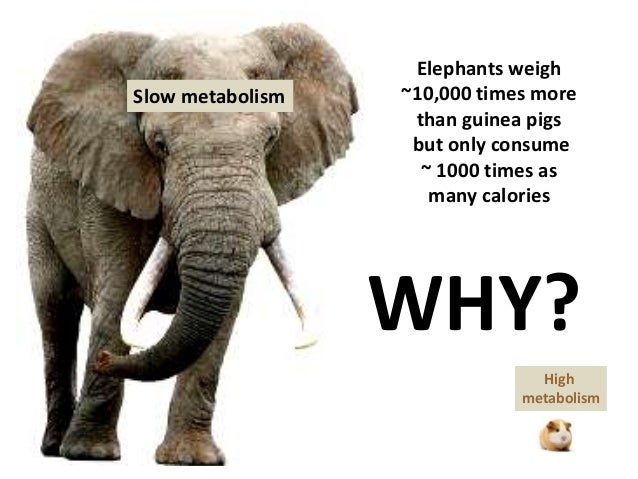
Elephants weigh ~10,000 times more than guinea pigs but only consume ~ 1000
times as many calories WHY? Slow metabolism High metabolism
56. 56.
<https://image.slidesharecdn.com/urbanecology18slideshare-180220033139/95/urban-ecology-56-638.jpg?cb=1519097575>
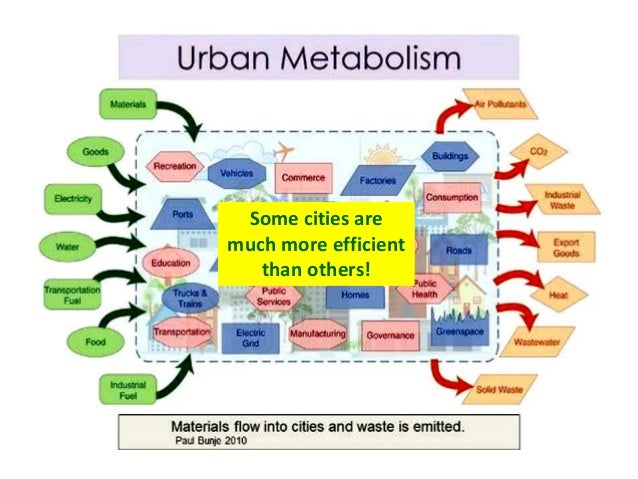
Some cities are much more efficient than others!
57. 57.
<https://image.slidesharecdn.com/urbanecology18slideshare-180220033139/95/urban-ecology-57-638.jpg?cb=1519097575>
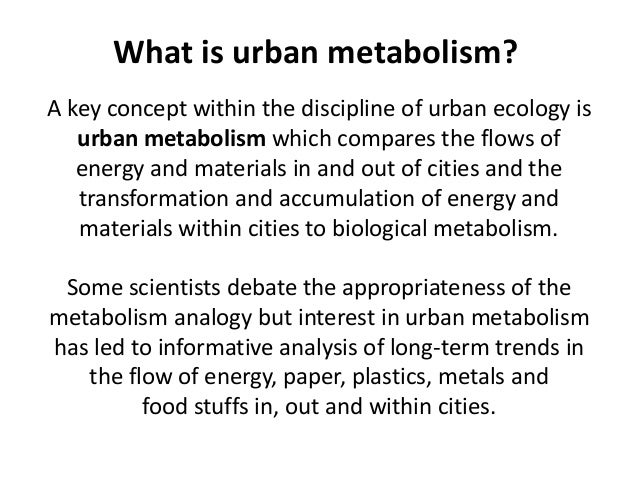
A key concept within the discipline of urban ecology is urban metabolism
which compares the flows of energy and materials in and out of cities and
the transformation and accumulation of energy and materials within cities
to biological metabolism. Some scientists debate the appropriateness of the
metabolism analogy but interest in urban metabolism has led to informative
analysis of long-term trends in the flow of energy, paper, plastics, metals
and food stuffs in, out and within cities. What is urban metabolism?
58. 58.
<https://image.slidesharecdn.com/urbanecology18slideshare-180220033139/95/urban-ecology-58-638.jpg?cb=1519097575>
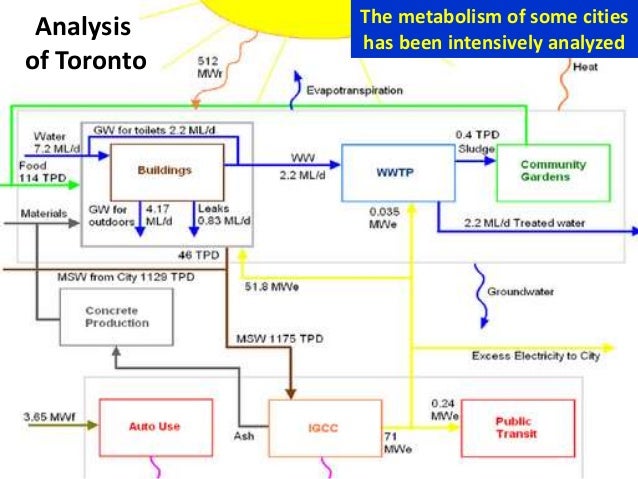
Analysis of Toronto The metabolism of some cities has been intensively
analyzed
59. 59.
<https://image.slidesharecdn.com/urbanecology18slideshare-180220033139/95/urban-ecology-59-638.jpg?cb=1519097575>
After studying Australian ant colonies, mathematicians think ants might
have something to teach us about network design, and how we evaluate
priorities in the placement of schools, post offices and power plants, and
the expansion of transportation systems. Models of ant colony growth, they
believe, can be used to improve the design of human systems.
60. 60.
<https://image.slidesharecdn.com/urbanecology18slideshare-180220033139/95/urban-ecology-60-638.jpg?cb=1519097575>
Many factors influence the metabolism of cities Sprawled, low-density
cities have higher per capita transportation energy requirements than
compact cities. Cities with interior continental climates expend more
energy on winter heating and summer cooling than those with more temperate
climates. Application of technology, appropriate use of vegetation and the
costs of energy influence energy consumption. Public policies (e.g.,
building codes and recycling programs) and social attitudes impact material
and energy flows. Lastly, the age of a city, the design of its
infrastructure, and its stage of industrial development impact its urban
metabolism.
61. 61.
<https://image.slidesharecdn.com/urbanecology18slideshare-180220033139/95/urban-ecology-61-638.jpg?cb=1519097575>
(Gigajoules/year/person) 1 gallon of gasoline per day Do you consume > 1
gallon of gasoline per day? Adapted from (Newman and Kenworthy, 1991)
62. 62.
<https://image.slidesharecdn.com/urbanecology18slideshare-180220033139/95/urban-ecology-62-638.jpg?cb=1519097575>
The City Solution Why cities are the best cure for our planet's growing
pains December 2011
63. 63.
<https://image.slidesharecdn.com/urbanecology18slideshare-180220033139/95/urban-ecology-63-638.jpg?cb=1519097575>
Large cities are concentrations of human ingenuity and generally require
far fewer resources on a per capita basis than small towns or rural areas.
64. 64.
<https://image.slidesharecdn.com/urbanecology18slideshare-180220033139/95/urban-ecology-64-638.jpg?cb=1519097575>
“Possibly the most exciting book on ecology or environmentalism to be
published in years, David Owen's Green Metropolis: Why Living Smaller,
Living Closer, and Driving Less Are the Keys to Sustainability challenges
the conventional wisdom of the environmental movement and uses New York
City (not Portland or rural Vermont) as a model of true sustainability.
Owen's seemingly counter-intuitive argument is supported by the data: New
Yorkers have the lowest per capita energy consumption and smallest per
capita carbon footprint of anyone in the United States. The key to this
isn't that New Yorkers are morally superior or ideologically predisposed to
environmentalism, but simply the structure of the city: “Manhattan's
density is approximately 67,000 people per square mile, or more than eight
hundred times that of the nation as a whole and roughly thirty times that
of Los Angeles.” http://nefac.net/greenmetro
65. 65.
<https://image.slidesharecdn.com/urbanecology18slideshare-180220033139/95/urban-ecology-65-638.jpg?cb=1519097575>
Perhaps most important, people in dense cities drive less. Their
destinations are close enough to walk to, and enough people are going to
the same places to make public transit practical. City dwellers tread more
lightly in many ways, David Owen explains in Green Metropolis. Their roads,
sewers, and power lines are shorter and so use fewer resources. Their
apartments take less energy to heat, cool, and light than do houses.
66. 66.
<https://image.slidesharecdn.com/urbanecology18slideshare-180220033139/95/urban-ecology-66-638.jpg?cb=1519097575>
New Delhi car ban yields trove of pollution data Scramble by researchers to
monitor driving restrictions in Indian capital pays off. New Delhi, India
may be the world’s most polluted city, but it’s making an effort to
relinquish that title. With pollution from particulate matter at
potentially lethal levels early last December, city officials took a
drastic step: they announced that they would temporarily restrict the use
of private vehicles by allowing owners to drive only on alternate days,
based on the their number plates #s. The initial results of that 15-day
trial, which began on 1 January, are now in. Although traffic actually
increased in the first week of the ban, the levels of PM2.5 — particulate
matter measuring less than 2.5 microns across — fell by roughly 10%. That
is a victory not just for New Delhi officials, but also for the scientists
who sprang into action to collect the data necessary to determine whether
the test had achieved its goal.
67. 67.
<https://image.slidesharecdn.com/urbanecology18slideshare-180220033139/95/urban-ecology-67-638.jpg?cb=1519097575>
In December 2015, daily levels of noxious PM2.5 in New Dehli ranged from
400–600 µg/m3 – much higher than the Indian legal standard of 60 µg/m3
(which itself is more than double the 25 µg/m3 target threshold set by the
World Health Organization). Scientists predict that PM2.5 particles cause
more than 600,000 premature deaths annually in India How serious is air
pollution in New Dehli?
68. 68.
<https://image.slidesharecdn.com/urbanecology18slideshare-180220033139/95/urban-ecology-68-638.jpg?cb=1519097575>

The high cost of suburban living is heavily subsidized by the rest of the
population in the form of public funds spent on road construction,
extension of utility lines, school buses and emergency services for new
developments. If the true cost of sprawl were borne by developers and
suburban home-buyers, in the form of increased housing prices, higher
property taxes and infrastructure recovery costs (e.g., higher utility
bills and tolls on roads primarily used by commuters) suburbs would be much
more expensive places to live.
69. 69.
<https://image.slidesharecdn.com/urbanecology18slideshare-180220033139/95/urban-ecology-69-638.jpg?cb=1519097575>
1.7 million people 3.6 million people 2.9 million people100 people ???
million people What do you know about Chicago?
70. 70.
<https://image.slidesharecdn.com/urbanecology18slideshare-180220033139/95/urban-ecology-70-638.jpg?cb=1519097575>
In the late 19th century, Chicago was a commercial colossus, a city growing
more quickly than New York, flooded with industrial money but ravaged by
great income disparities, lax health standards, and labor upheavals. For
Chicago to become the city it could be, civic leaders recognized the need
for urban planning, both to solve Chicago's existing problems and to
prepare it for a prosperous future. The result was architect Daniel
Burnham's 1909 plan for Chicago, a model of urban planning, aesthetic
sophistication, and technical achievement.
71. 71.
<https://image.slidesharecdn.com/urbanecology18slideshare-180220033139/95/urban-ecology-71-638.jpg?cb=1519097575>
Congress Parkway Arterial street widening Civic Center Chicago River
straightening Roosevelt Road Grant Park Northerly Island New diagonal
avenues Consolidated railroad stations Two-level riverfront drives Make no
little plans. They have no magic to stir men’s blood and probably
themselves will not be realized. Make big plans; aim high in hope and work,
remembering that a noble, logical diagram once recorded will never die. D.
Burnham
72. 72.
<https://image.slidesharecdn.com/urbanecology18slideshare-180220033139/95/urban-ecology-72-638.jpg?cb=1519097575>
Chicago has a long history of big plans!
73. 73.
<https://image.slidesharecdn.com/urbanecology18slideshare-180220033139/95/urban-ecology-73-638.jpg?cb=1519097575>
What happens to storm water in Chicago?
74. 74.
<https://image.slidesharecdn.com/urbanecology18slideshare-180220033139/95/urban-ecology-74-638.jpg?cb=1519097575>
A very grand solution
75. 75.
<https://image.slidesharecdn.com/urbanecology18slideshare-180220033139/95/urban-ecology-75-638.jpg?cb=1519097575>
The Thornton Reservoir is the final stage of the TARP tunnel project's
Calumet branch. When the former limestone quarry fills, it will add 7.9
billion more gallons of capacity to Chicago’s stormwater runoff system.
76. 76.
<https://image.slidesharecdn.com/urbanecology18slideshare-180220033139/95/urban-ecology-76-638.jpg?cb=1519097575>
Thorton Reservoir ~ 8 billion gallons!
77. 77.
<https://image.slidesharecdn.com/urbanecology18slideshare-180220033139/95/urban-ecology-77-638.jpg?cb=1519097575>
“If you look around at major cities in the country, Chicago had so much
foresight – and as a result is spending far less, and benefiting so much
more than other cities,” says David St. Pierre, executive director of the
Metropolitan Water Reclamation District in regard to efforts to keep storms
from flooding cities.
78. 78.
<https://image.slidesharecdn.com/urbanecology18slideshare-180220033139/95/urban-ecology-78-638.jpg?cb=1519097575>
improving stormwater management by reducing runoff and improving water
quality reducing heating and cooling costs increasing longevity of
roofing membranes reducing noise and air pollution increasing urban
biodiversity providing space for urban agriculture providing a more
aesthetically pleasing and healthy environment to work and live
79. 79.
<https://image.slidesharecdn.com/urbanecology18slideshare-180220033139/95/urban-ecology-79-638.jpg?cb=1519097575>
Chicago City Hall
80. 80.
<https://image.slidesharecdn.com/urbanecology18slideshare-180220033139/95/urban-ecology-80-638.jpg?cb=1519097575>
LEED, or Leadership in Energy & Environmental Design, is a green building
certification program that recognizes best-in-class building strategies and
practices. To receive LEED certification, building projects satisfy
prerequisites and earn points to achieve different levels of certification.
81. 81.
<https://image.slidesharecdn.com/urbanecology18slideshare-180220033139/95/urban-ecology-81-638.jpg?cb=1519097575>
LEED v4 is bolder, more specialized, and designed for an improved user
experience. There are 4 levels of certification
82. 82.
<https://image.slidesharecdn.com/urbanecology18slideshare-180220033139/95/urban-ecology-82-638.jpg?cb=1519097575>
The WIU Multicultural Center is built to LEED 2.2 Silver criteria!
83. 83.
<https://image.slidesharecdn.com/urbanecology18slideshare-180220033139/95/urban-ecology-83-638.jpg?cb=1519097575>
If what you value most is nature, cities look like concentrated piles of
damage—until you consider the alternative, which is spreading the damage.
http://www.airphotona.com/image.asp?imageid=15204
84. 84.
<https://image.slidesharecdn.com/urbanecology18slideshare-180220033139/95/urban-ecology-84-638.jpg?cb=1519097575>
Cities allow more than half of humanity to live on <3% of the earth’s
arable land, leaving more space for nature.
http://media.treehugger.com/assets/images/2012/03/bishan-park-singapore-aerial-vew.jpg.492x0_q85_crop-smart.jpg

85. 85.
<https://image.slidesharecdn.com/urbanecology18slideshare-180220033139/95/urban-ecology-85-638.jpg?cb=1519097575>
Positive human experiences with non-native, global “homogenizers”, such as
pigeons, may be essential for convincing urbanites of the importance of
conserving global biodiversity. With an ever-increasing fraction of humans
living in cities, encounters with urban nature have supplanted experiences
with natural biodiversity for many people.
86. 86.
<https://image.slidesharecdn.com/urbanecology18slideshare-180220033139/95/urban-ecology-86-638.jpg?cb=1519097575>
Most Americans don’t like cities. In an annual Gallup poll, from 1966 to
the present day, the number of Americans who have reported a preference for
city living has never been higher than 20 percent. (The other options
Gallup provides are small town, farm or suburb.) Steven Conn’s new book,
Americans Against the City: Anti- Urbanism in the Twentieth Century
analyzes the causes and effects of Americans’ anti-city sentiment. Despite
all their benefits
Joel
Joel Gruver
Associate Professor of Soil Science
School of Agriculture
Western Illinois University
knorth
Feb 20
Joel,
Your urban ecology slides contain a lot of useful information. However,
they lack proper integration into a whole systems analysis. The urban
systems and their hinterlands are both ecosystems and political economies,
and cannot be well understood without that integration. For example, cities
are flagship cores, the embodiment of whole civilizations, whole ways of
living that exploit natural resources and people extremely unsustainably
since the advent of agriculture. The poverty of a large percentage of urban
dwellers is the result of various types of enclosure, forcing peasant
populations into cities and factories.
Secondly, most of the urban green design in the slides is too little, too
late. Moreover, most urban ecologists and other 'new urbanists' use loose
definitions of efficiency and cost measurement typical of an age of over
two centuries of rampant use of resources due to cheap energy (see my paper
below). That age is over.
For example, the value of compactness in communities, promoted by urban
designers, is "green" only at very small scale. Europe is full of such
compact small towns and agrarian villages, the legacy of a pre-industrial
age (again, see my paper, below). Colonization and resource exploitation in
the US rarely followed the European pattern, whose historical remnants are
better models for the future.
The real problem, which most people avoid, is overpopulation and its per
capita consumption patterns in the industrial countries. That cities of any
size are unsustainable is revealed by fully burdened cost accounting
pioneered by HT Odum, Charles Hall and other systems ecologists, who count
emergy (that's with an 'M') costs, for example.
Wood, the primary stored energy source before the advent of fossil fuels,
was already scarce in Europe in 1600, driving colonization of the New
World. Here is years of wood that current US state populations would have
without fossil fuels. The legend shows fractions of years, so it actually
comes down down to a few days in most states, at current population levels.
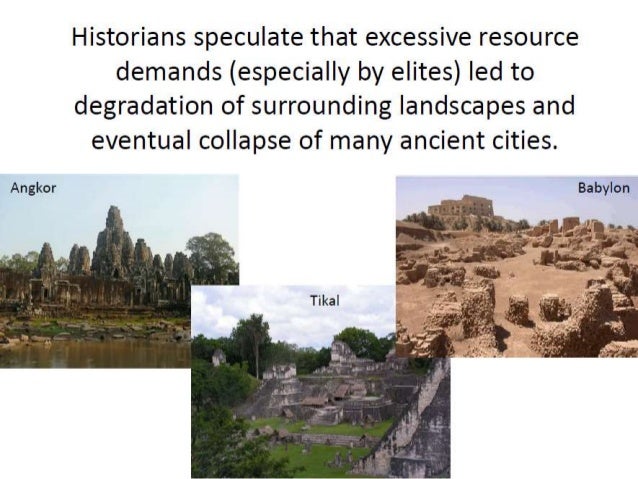
Also, an integrated approach also needs a historical overview that shows
patterns of urban civilization rise and fall.
In the future, human communities of any type will have to make do with NPP
as a resource base, like all other species, and like natural ecosystems.
This will shrink human population drastically, ending most city life. Here
are some scenarios based on those ecological imperatives.
Cities and Suburbs in the Energy Descent: Thinking in Scenarios
<http://karlnorth.com/?p=553>
--
Karl North - http://karlnorth.com/
"Pueblo que canta no morira" - Cuban saying
"They only call it class warfare when we fight back" - Anon.
"My father rode a camel. I drive a car. My son flies a jet-plane. His son
will ride a camel."
—Saudi saying
--
Lawrence F. London, Jr.
lfljvenaura@gmail.com
https://sites.google.com/site/avantgeared


- [permaculture] Urban Ecology, a slideshow by Joel Gruver, Lawrence London, 07/02/2018
Archive powered by MHonArc 2.6.24.