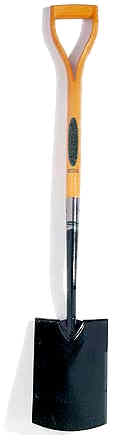
The essence of it is that you invest a lot of effort and materials up
front, inverting the soil, fragmenting the crumb structure, with
associated temporary disruption of soil life and soil structure,
oxidation of organic matter and release of co2 through exposure of humus
to air in order to improve soil tilth, fertility, drainage, water
holding capacity,
cation exchange capacity, organic matter content and overall soil
quality provifing an
improved and healthy medium for hosting beneficial microorganisms and
other creatures
that make garden soil their home. You remove much of the soil in the
bed, add organic
matter and mineral based soil amendments to it, homogenize these
materials then
return the amended, enriched soil mix to the bed. This is done in
increments of one (typical short (42" to 48") English D-handled *see
below) digging
spade blade width wide and one spade blade length deep for the width of
the bed (38-50" wide depending on the gardener's height).
You want highly mineralized soil, high in tilth and fertility, producing
vegetables and fruits with exceptional flavor.
Add rock dust from quarries to your garden soil for trace minerals,
microbe food and tilth, permanently eliminating soil
compaction. This is called siltation pond fines. It is so fine that if
you put some in a glass of water it turns cloudy
and stays that way for quite a while before settling into a layer of
sludge on the bottom; so fine it would take a microscope
to see the individual particles. This is great material to feed plants
and soil microorganisms and invertebrates in your garden.
I think we are talking 200 mesh or finer; some fines are a little coarse
by comparison to my basalt/tuff fines and some are an
aggregate with the largest component almost microscopic, like the talcum
powder in pyrophylite fines (dredged from the quarry's siltation ponds).
To prevent compaction, permanently, fines act mechanically to interfere
with clay and silt particles that when compressed when wet become highly
compacted when dried out - a serious problem for gardeners needing
productive high-tilth soil.
I have used this material to enrich soil for the benefit of plants,
microorganisms and invertebrates and to permanently
prevent any compaction of my soil that would significantly reduce the
productivity of the gardens. The materials include
"siltation pond fines" from the following types of rock: granite,
volcanic tuff (maybe basalt, very hard rock, 2nd hardest in NC)
and pyrophyllite screenings. I am glad to hear that granite, high in
silica is a sink for lime making my soil acidic,
good for most crops, pH 6.1 to 6.6 or so. Tillage is expensive,
disruptive of soil life and inconvenient when it needs to be done
and the soil is too wet; i.e. weeds can get out of control and go to
seed when tillage can't be done, like in Spring, to remove them and
create a fine, weed free seedbed for new plantings. Fines are mixed with
existing soil on site, sometimes in a 30 or 40 to 50 ratio.
The clay or silt particles become permanently separated from each other
and cannot be seriously compacted again.
This effect is also achieved with the addition of compost or manures to
the soil. The fines feed the microorganisms
that help break down the fines and make trace minerals available to
plants; these microbes also break down any raw or composted organic matter
added to soil to become humus, feed released nutrients to crops and
improve the soil crumb structure providing added tilth to your garden soil.
The extra trace minerals in garden soil makes crops taste much better.
The famous tomatoes grown in volcanic soils in places in Italy taste so
good for this same reason. That's how fines relieve compaction and add
to soil health and vitality, crop health and disease and predator
resistance and crop flavor, appearance and keeping qualities. More about
fines dissolved in water. In places in the high country areas in
Eastern countries people drink cold river water that is cloudy and high
in mineral content; they live long lives.
I would remove the top 8" or more of your raised bed-to-be. Then, "in
situ" (without turning or inverting the soil layers) tilth
or dig up and pulverize an additional, lower 8-12" of subsoil; add
amendments of all sorts to the 8" of soil you removed then put
it back in place on top of the subsoil layers you just tilthed - then
you will have a "raised bed", the new garden bed surface will
now extend 4-8" above existing grade.
This will address any concern about your garden drying out during
drought times if you use raised beds. The benefits outweigh the
disadvantages and with the following technique you will have no problems
whatsoever.
Avoid having paths between the beds that are level with existing grade
but ditches or furrows between the beds. These provide
much needed drainage and you can fill these ditches with mulch, weeds,
hay, etc all the way up to the tops of your raised beds.
You want to to accomplish the objective of increasing depth of tilth and
fertility in the soil in your beds. Mulching the top layer is
mandatory. Mulch will decompose leaving the seedbed fine and loose while
leaching humus and compost tea into lower layers of garden soil
including sub soil areas to depths of several feet (partly because you
have already tilled this zone). You want a permanent, notill,
biointensive raised bed that gets better each year through the action of
compost tea, humus and nutrients that leach from the top layers
into the lower layers; that's a real "trickle-down bioeco-economy" with
big pay back in quality produce for the table and for market.
This is real Pay Dirt as J.I. Rodale described it.
After this process is completed you need never again turn your soil,
except to a depth no greater than is necessary to control newly emerging
weeds, break crust and create a fine, loose seedbed. You now have
biointensive no-till, permanent raised beds.
This technology has been around for centuries and it works.
There is a very big net gain for soil, its inhabitants and the environment.
See John Jeavons books, Alan Chadwick's literature and lectures (links
on my website) and Aquatias' "Intensive Culture of Vegetables, French
System".
Double digging is as essential and indispensible to gardening anywhere
in the world, where the climate does not mandate other methods, as grain
is to bread.
* -> One of these spades:
Wooden D-handled digging spade:
28" length for most people, 32" for tall people or get the long straight
handled version, see below. http://www.bulldogtools.co.uk/img/products/thumbnails/5610012820_500x263.jpg http://www.bulldogtools.co.uk/index.php?mod=3&id=7&rid=1
Long straight handled version: http://www.bulldogtools.co.uk/index.php?mod=3&id=12&rid=1
This is the big dog on the block when it comes to traditional English
hand gardening tools; these were available at the beginning of the
modern organic gardening and farming movement in the 1960's:
Bulldog - Quality Garden, Contractor and Agricultural Tools
Rollins Bulldog Tools
"Bulldog Tools have been made at Clarington Forge in Wigan, England, for
over 200 years. Generations of Farmers, Contractors and Professional
Landscapers stand testimony to a quality of product upon which their
livelihoods depend. The skill and craftsmanship that were the key to the
company's success in those early days are still maintained and are
available to this day."
\|/
=
/|\
For hand tools unavailable elsewhere in the USA see:
EARTH TOOLS, Inc.
Walk-Behind Tractors and Compatible Implements
hand tools for gardeners, homesteaders and farmers.
1525 Kays Branch Road
Owenton, KY 40359 http://earthtoolsbcs.com
(502) 484-3988 tel.
(502) 484-3357 fa
Indispensable tools from them include:
G30 - DeWit Seed Bed Rake
Made of forged steel, the 9 super-heavy duty tines are spaced nearly 2”
apart - perfect for ripping up and raking organic material out of old
seed beds without pulling all the soil out too. Straight neck allows you
to flip over and use the back to flatten bed.
Head: 16.5” x 4”
Length: 74”
Weight: 4.4 lbs
Price: $59.00
53565 - SHW ‘Root’ Hoe
Heavier head for tougher chopping applications.
Head: 4.5” x 8.5”
Weight: 4.4 lbs
Length: 54”
Price: $43.00
Length: 75”
Price: $49.00
54306 - SHW Grape Hoe
The 'Big Mama' of hoes, available with your choice of two handle lengths
(head shipped dis-mounted from handle)
Head: 9.5” x 7”
Weight: 5 lbs
Length: 54”
Price: $46.00
Length: 75”
Price: $50.00
Double digging is useful when drainage needs to be improved, or if the
ground has not been previously cultivated. This is a time-consuming
process but is worth the hard work and will result in good soil.
Glomalin, extracted from
undisturbed Nebraska soil and
then freeze-dried.
(K9969-2)
A sticky protein seems to be the unsung hero of soil carbon storage.
Until its discovery in 1996 by ARS soil scientist Sara F. Wright, this
soil "super glue" was mistaken for an unidentifiable constituent of soil
organic matter. Rather, it permeates organic matter, binding it to silt,
sand, and clay particles. Not only does glomalin contain 30 to 40
percent carbon, but it also forms clumps of soil granules called
aggregates. These add structure to soil and keep other stored soil
carbon from escaping.
As a glycoprotein, glomalin stores carbon in both its protein and
carbohydrate (glucose or sugar) subunits. Wright, who is with the
Sustainable Agricultural Systems Laboratory in Beltsville, Maryland,
thinks the glomalin molecule is a clump of small glycoproteins with iron
and other ions attached. She found that glomalin contains from 1 to 9
percent tightly bound iron.
A microscopic view of an arbuscular mycorrhizal fungus: Click here for
full photo caption.
A microscopic view of an
arbuscular mycorrhizal fungus
growing on a corn root. The
round bodies are spores, and
the threadlike filaments are
hyphae. The substance coating
them is glomalin, revealed by
a green dye tagged to an
antibody against glomalin.
(K9968-1)
Glomalin is causing a complete reexamination of what makes up soil
organic matter. It is increasingly being included in studies of carbon
storage and soil quality. In fact, the U.S. Department of Energy, as
part of its interest in carbon storage as an offset to rising
atmospheric carbon dioxide (CO2) levels, partially funded a recent study
by lab technician Kristine A. Nichols, a colleague of Wright's. Nichols
reported on the study as part of her doctoral dissertation in soil
science at the University of Maryland.
That study showed that glomalin accounts for 27 percent of the carbon in
soil and is a major component of soil organic matter. Nichols, Wright,
and E. Kudjo Dzantor, a soil scientist at the University of
Maryland-College Park, found that glomalin weighs 2 to 24 times more
than humic acid, a product of decaying plants that up to now was thought
to be the main contributor to soil carbon. But humic acid contributes
only about 8 percent of the carbon. Another team recently used carbon
dating to estimate that glomalin lasts 7 to 42 years, depending on
conditions.
For the study, the scientists compared different chemical extraction
techniques using eight different soils from Colorado, Georgia, Maryland,
and Nebraska. They found that current assays greatly underestimate the
amount of glomalin present in soils. By comparing weights of extracted
organic matter fractions (glomalin, humic acid, fulvic acid, and
particulate organic matter), Nichols found four times more glomalin than
humic acid. She also found that the extraction method she and Wright use
underestimates glomalin in certain soils where it is more tightly bound
than usual.
Soil scientist examines a soil aggregate coated with glomalin: Click
here for full photo caption.
In her Beltsville laboratory,
soil scientist Sara Wright
examines a soil aggregate
coated with glomalin, a soil
protein she identified in 1996.
(K9972-1)
In a companion study, Nichols, Wright, and Dzantor teamed up with ARS
chemist Walter F. Schmidt to examine organic matter extracted from the
same soils under a nuclear magnetic resonance (NMR) imager. They found
that glomalin's structure differs from that of humic acid—or any other
organic matter component—and has unique structural units.
In a current study in Costa Rica, partly funded by the National Science
Foundation, Wright is using glomalin levels and root growth to measure
the amount of carbon stored in soils beneath tropical forests. She is
finding lower levels of glomalin than expected and a much shorter
lifespan. "We think it's because of the higher temperatures and moisture
in tropical soils," she explains. These factors break down glomalin.
Forests, croplands, and grasslands around the world are thought to be
valuable for offsetting carbon dioxide emissions from industry and
vehicles. In fact, some private markets have already started offering
carbon credits for sale by owners of such land. Industry could buy the
credits as offsets for their emissions. The expectation is that these
credits would be traded just as pollution credits are currently traded
worldwide.
Soil scientist and technician examine extracted soil organic matter
constituents: Click here for full photo caption.
Soil scientist Sara Wright
(foreground) and technician
Kristine Nichols use nuclear
magnetic resonance to examine
the molecular structure of
extracted soil organic matter
constituents.
(K9971-1)
How Does Glomalin Work?
It is glomalin that gives soil its tilth—a subtle texture that enables
experienced farmers and gardeners to judge great soil by feeling the
smooth granules as they flow through their fingers.
Arbuscular mycorrhizal fungi, found living on plant roots around the
world, appear to be the only producers of glomalin. Wright named
glomalin after Glomales, the taxonomic order that arbuscular mycorrhizal
fungi belong to. The fungi use carbon from the plant to grow and make
glomalin. In return, the fungi's hairlike filaments, called hyphae,
extend the reach of plant roots. Hyphae function as pipes to funnel more
water and nutrients—particularly phosphorus—to the plants.
"We've seen glomalin on the outside of the hyphae, and we believe this
is how the hyphae seal themselves so they can carry water and nutrients.
It may also be what gives them the rigidity they need to span the air
spaces between soil particles," says Wright.
Technician checks progress of corn plants: Click here for full photo
caption.
Technician Kristine Nichols
checks the progress of corn
plants growing in containers
specially designed for
glomalin production.
(K9973-1)
As a plant grows, the fungi move down the root and form new hyphae to
colonize the growing roots. When hyphae higher up on the roots stop
transporting nutrients, their protective glomalin sloughs off into the
soil. There it attaches to particles of minerals (sand, silt, and clay)
and organic matter, forming clumps. This type of soil structure is
stable enough to resist wind and water erosion, but porous enough to let
air, water, and roots move through it. It also harbors more beneficial
microbes, holds more water, and helps the soil surface resist crusting.
Scientists think hyphae have a lifespan of days to weeks. The much
longer lifespan of glomalin suggests that the current technique of
weighing hyphae samples to estimate fungal carbon storage grossly
underestimates the amount of soil carbon stored. In fact, Wright and
colleagues found that glomalin contributes much more nitrogen and carbon
to the soil than do hyphae or other soil microbes.
Two rows of dried soil samples: Click here for full photo caption.
Dried samples of undisturbed
soil (top row) and material
left after extractable organic
matter has been removed
(bottom row). Although minerals
are the most abundant components
of soil, organic matter gives
it life and health. Soil
samples from left to right
are from Maryland, Nebraska,
Georgia, and Colorado.
(K9974-1)
Rising CO2 Boosts Glomalin, Too
In an earlier study, Wright and scientists from the University of
California at Riverside and Stanford University showed that higher CO2
levels in the atmosphere stimulate the fungi to produce more glomalin.
They did a 3-year study on semiarid shrub land and a 6-year study on
grasslands in San Diego County, California, using outdoor chambers with
controlled CO2 levels. When CO2 reached 670 parts per million (ppm)—the
level predicted by mid to late century—hyphae grew three times as long
and produced five times as much glomalin as fungi on plants growing with
today's ambient level of 370 ppm.
Longer hyphae help plants reach more water and nutrients, which could
help plants face drought in a warmer climate. The increase in glomalin
production helps soil build defenses against degradation and erosion and
boosts its productivity.
Wright says all these benefits can also come from good tillage and soil
management techniques, instead of from higher atmospheric CO2.
"You're in the driver's seat when you use techniques proven to do the
same thing as the higher CO2 that might be causing global warming. You
can still raise glomalin levels, improve soil structure, and increase
carbon storage without the risks of the unknowns in global climate
change," she says.
Putting Glomalin to Work
Wright found that glomalin is very manageable. She is studying glomalin
levels under different farming and ranching practices. Levels were
maintained or raised by no-till, cover crops, reduced phosphorus inputs,
and the sparing use of crops that don't have arbuscular mycorrhizal
fungi on their roots. Those include members of the Brassicaceae family,
like cabbage and cauliflower, and the mustard family, like canola and
crambe.
"When you grow those crops, it's like a fallow period, because glomalin
production stops," says Wright. "You need to rotate them with crops that
have glomalin-producing fungi."
In a 4-year study at the Henry A. Wallace Beltsville (Maryland)
Agricultural Research Center, Wright found that glomalin levels rose
each year after no-till was started. No-till refers to a modern
conservation practice that uses equipment to plant seeds with no prior
plowing. This practice was developed to protect soil from erosion by
keeping fields covered with crop residue.
Glomalin went from 1.3 milligrams per gram of soil (mg/g) after the
first year to 1.7 mg/g after the third. A nearby field that was plowed
and planted each year had only 0.7 mg/g. In comparison, the soil under a
15-year-old buffer strip of grass had 2.7 mg/g.
Wright found glomalin levels up to 15 mg/g elsewhere in the Mid-Atlantic
region. But she found the highest levels—more than 100 mg/g—in Hawaiian
soils, with Japanese soils a close second. "We don't know why we found
the highest levels in Hawaii's tropical soils. We usually find lower
levels in other tropical areas, because it breaks down faster at higher
temperature and moisture levels," Wright says. "We can only guess that
the Hawaiian soils lack some organism that is breaking down glomalin in
other tropical soils—or that high soil levels of iron are protecting
glomalin."
It's Persistent and It's Everywhere!
The toughness of the molecule was one of the things that struck Wright
most in her discovery of glomalin. She says it's the reason glomalin
eluded scientific detection for so long.
"It requires an unusual effort to dislodge glomalin for study: a bath in
citrate combined with heating at 250 °F for at least an hour," Wright
says. "No other soil glue found to date required anything as drastic as
this."
"We've learned that the sodium hydroxide used to separate out humic acid
in soil misses most of the glomalin. So, most of it was thrown away with
the insoluble humus and minerals in soil," she says. "The little bit of
glomalin left in the humic acid was thought to be nothing more than
unknown foreign substances that contaminated the experiments."
Once Wright found a way to capture glomalin, her next big surprise was
how much of it there was in some soils and how widespread it was. She
tested samples of soils from around the world and found glomalin in all.
"Anything present in these amounts has to be considered in any studies
of plant-soil interactions," Wright says. "There may be implications
beyond the carbon storage and soil quality issues—such as whether the
large amounts of iron in glomalin mean that it could be protecting
plants from pathogens."
Her recent work with Nichols has shown that glomalin levels are even
higher in some soils than previously estimated.
"Glomalin is unique among soil components for its strength and
stability," Wright says. Other soil components that contain carbon and
nitrogen, as glomalin does, don't last very long. Microbes quickly break
them down into byproducts. And proteins from plants are degraded very
quickly in soil.
"We need to learn a lot more about this molecule, though, if we are to
manage glomalin wisely. Our next step is to identify the chemical makeup
of each of its parts, including the protein core, the sugar
carbohydrates, and the attached iron and other possible ions." Nichols
is starting to work on just that.
"Once we know what sugars and proteins are there," says Nichols, we will
use NMR and other techniques to create a three-dimensional image of the
molecule. We can then find the most likely sites to look for iron or
other attached ions.
"Researchers have studied organic matter for a long time and know its
benefits to soil. But we're just starting to learn which components of
organic matter are responsible for these benefits. That's the exciting
part of glomalin research. We've found a major component that we think
definitely has a strong role in the benefits attributed to organic
matter—things like soil stability, nutrient accessibility, and nutrient
cycling."
As carbon gets assigned a dollar value in a carbon commodity market, it
may give literal meaning to the expression that good soil is black gold.
And glomalin could be viewed as its golden seal.—By Don Comis,
Agricultural Research Service Information Staff.
This research is part of Soil Resource Management, an ARS National
Program (#202) described on the World Wide Web at http://www.nps.ars.usda.gov.
Sara F. Wright and Kristine A. Nichols are with the USDA-ARS Sustainable
Agricultural Systems Laboratory, Bldg. 001, 10300 Baltimore Ave.,
Beltsville, MD 20705; phone (301) 504-8156 [Wright], (301) 504-6977
[Nichols], fax (301) 504-8370.
"Glomalin: Hiding Place for a Third of the World's Stored Soil Carbon"
was published in the September 2002 issue of Agricultural Research
magazine.
[permaculture] Venaura Farm Permaculture: Permanent Biointensive Double-dug Garden Preparation & Handtool Information & Sourcelist,
Lawrence F. London, Jr., 05/11/2010